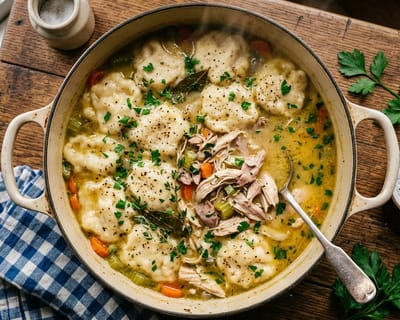
Southern Chicken and Dumplings
Whole chicken simmered into a rich, golden homemade bone broth with carrots and celery, loaded with tender rolled flat pastry dumplings that thicken the stew into velvety comfort food.
Key Takeaways
- ✓Ready in just 1 hour 20 mins using straightforward, kitchen-tested technique.
- ✓Delivers 38g of muscle-fueling protein per serving for lasting satiety.
- ✓Portion-balanced at 520 calories per serving with wholesome, unrefined ingredients.
- ✓Masterclass temperature checkpoints ensure maximum tenderness and flavor development.
The Story
Few dishes embody the comforting soul of Southern country cooking quite like homemade Chicken and Dumplings. Born from rural practicality and passed down through generations across the American South, this one-pot meal combines a slow-simmered whole chicken, rich golden bone broth, sweet aromatic vegetables, and tender, chewy rolled pastry dumplings that thicken the soup into a luxurious, spoon-coating gravy.
Despite the humble nature of the ingredients, authentic Southern chicken and dumplings often eludes modern home cooks. Common missteps include using store-bought boxed broth with dry shredded chicken breasts, ending up with soggy dough balls that dissolve into library paste, or producing heavy, leaden dumplings that sink like rocks.
Mastering this dish requires honoring classical culinary physics: extracting gelatin and marrow from a whole stewing hen or roasting chicken, understanding the starch chemistry of rolled pastry "slickers," and managing heat dynamics during the dumpling simmer.
Rolled vs. Drop: The Great Southern Dumpling Divide
Across the United States, culinary geography defines two distinct styles of dumplings:
1. Rolled Flat Dumplings (Southern "Slickers" or Pastry Dumplings)
In the American South—from Virginia and the Carolinas through Georgia, Alabama, Mississippi, and Tennessee—dumplings are rolled flat.- The dough consists of flour, salt, leavening, fat (butter, shortening, or lard), and liquid.
- The dough is rolled thin on a heavily floured board and sliced with a knife or pizza wheel into rectangular squares or strips (roughly 1.5 inches wide by 3 inches long).
- Because these dumplings slide smoothly off the spoon and have a tender, pasta-like chew, rural Southerners affectionately call them "slickers" or "slicks."
- As the heavily floured dough strips simmer in the hot broth, the exterior flour dissolves into the soup, naturally thickening the broth into a rich, velvety gravy without requiring a roux or cornstarch slurry.
2. Drop Dumplings (Fluffy Biscuit Style)
Common in the Midwest, Pennsylvania Dutch country, and New England, drop dumplings use a wetter, loose batter dropped into the bubbling stew by the spoonful.- When covered with a tight lid, the leavening agent (baking powder) causes the batter to puff up dramatically through steam leavening.
- These emerge as round, cloud-like, spongy biscuit balls that float on top of the broth. While enjoyable, they lack the velvety gravy-thickening starch of true Southern rolled pastry slickers.
The Foundation: Building a Real Golden Bone Broth
You cannot make transcendent chicken and dumplings with commercial boxed broth and rotisserie chicken breast. The soul of the dish lies in the broth:
1. Whole Chicken Collagen and Gelatin Extraction
A whole cut-up roasting chicken (or stewing hen) contains an intricate network of bones, cartilage, skin, and connective tissue.- As the chicken simmers gently in cold water between 175°F and 190°F (79°C to 88°C) over 60 to 75 minutes, heat causes the triple-helix collagen molecules in the bones and joints to unravel and undergo hydrolysis, converting into soluble gelatin.
- When dissolved in the water, this gelatin imparts an unmistakable rich mouthfeel—a natural body and silkiness that coats the palate.
2. The Two-Stage Vegetable Strategy
A common mistake is simmering the carrots, celery, and onions for the entire 90 minutes.- Vegetables simmered for over an hour exhaust their volatile aromatic compounds and collapse into gray mush.
- The proper technique uses a two-stage method: simmer the large aromatic trimmings (onion quarters, celery tops, garlic, bay leaves) with the whole chicken to build deep background flavor, then strain them out.
- Fresh, neatly sliced carrots and celery are added later with the picked chicken meat and dumplings, ensuring sweet, tender-crisp vegetable bites in the finished bowl.
The Chemistry of Rolled Dumpling Dough
The texture of a rolled dumpling hinges on controlling gluten formation and fat dispersion:
- The Fat (Butter or Lard): Working cold butter or lard into the flour coats the flour proteins (gliadin and glutenin) with a microscopic lipid layer. This "shortens" the gluten strands, ensuring the cooked dumplings are tender rather than rubbery.
- The Liquid (Warm Broth): Using warm, freshly skimmed chicken broth directly from the simmering pot to hydrate the dough melts the butter slightly, creating a supple, pliable dough that rolls out easily without snapping back.
- The Counter Air-Dry Ritual: After rolling the dough paper-thin (about 1/8 inch thick) and cutting it into strips, leave the dumplings undisturbed on the floured counter for 15 to 20 minutes. Allowing ambient air to dry the surface creates a thin, starch-dense skin that prevents the dumplings from dissolving or disintegrating when dropped into bubbling liquid.
Step-by-Step Instructions
Follow these steps for authentic Southern rolled chicken and dumplings:
Step 1: Simmer the Whole Chicken Stock
Place a 4 1/2 to 5-pound cut-up whole chicken into a large heavy Dutch oven or stockpot. Add 10 cups of cold water, ensuring the chicken pieces are submerged.Add 2 quartered yellow onions, 1 chopped carrot, 1 chopped celery stalk (with leafy tops), 5 smashed garlic cloves, 2 bay leaves, 4 thyme sprigs, 4 parsley sprigs, 1 tablespoon of kosher salt, and 1 teaspoon of whole black peppercorns.
Bring to a boil over medium-high heat. As foam and impurities rise to the surface during the first 10 minutes, skim them off with a wide spoon and discard. Reduce heat to medium-low, cover partially with the lid, and simmer gently for 55 to 65 minutes, until the chicken meat is tender and easily separates from the bone.
Step 2: Strain the Broth and Shred the Meat
Use tongs to transfer the cooked chicken pieces to a large rimmed baking sheet. Let cool for 15 minutes until safe to handle. Discard the chicken skin and bones; shred or pull the warm white and dark meat into bite-sized chunks. Cover the meat with a sheet of foil to keep it moist.Pour the contents of the pot through a fine-mesh sieve set over a large heatproof bowl. Press gently on the spent vegetables and aromatics to extract remaining liquid, then discard the solids. Skim excess clear yellow fat from the top of the strained broth, reserving 2 tablespoons of this flavorful chicken fat. You should have roughly 7 to 8 cups of rich, golden broth.
Return the strained broth to the Dutch oven and place over low heat.
Step 3: Mix the Rolled Dumpling Dough
In a large mixing bowl, whisk together 2 cups of all-purpose flour, 1 teaspoon of baking powder, and 1 teaspoon of fine sea salt.Add 4 tablespoons of cold unsalted butter (cut into small cubes) or shortening. Use a pastry blender, two forks, or your fingertips to work the fat into the dry flour until the mixture resembles coarse meal with pea-sized crumbs.
Make a well in the center of the flour. Pour in 3/4 cup of warm chicken broth (ladled directly from the pot) or whole milk. Stir with a wooden spoon just until a shaggy, cohesive dough comes together. If the dough feels too dry, add an extra tablespoon of warm broth. Do not over-knead.
Step 4: Roll, Cut, and Rest the Dumplings
Generously dust a clean wooden cutting board or countertop with all-purpose flour. Turn the dough out and press it into a flat disc. Dust the top of the dough and your rolling pin with flour.Roll the dough out firmly from the center toward the edges until it is roughly 1/8-inch thick (uniform thickness is key so all dumplings cook at an identical rate).
Using a sharp chef's knife or a pizza cutting wheel, slice the rolled dough into long strips roughly 1 1/2 inches wide. Then crosscut the strips every 2 1/2 to 3 inches to form rectangular dumplings. Dust the cut dumplings generously with extra flour so they do not stick together.
Let the cut dumplings rest undisturbed on the floured counter for 15 to 20 minutes to air-dry and set their exterior surface.
Step 5: Build the Stew Base
While the dumplings dry, bring the strained golden broth in the Dutch oven to a steady simmer over medium heat.Add 2 sliced carrots, 2 sliced stalks of celery, 1/2 teaspoon of freshly cracked black pepper, and 1/4 teaspoon of dried poultry seasoning (or rubbed sage). Simmer for 8 to 10 minutes until the vegetables begin to soften.
Step 6: Drop and Simmer the Dumplings
Ensure the broth is at a steady, active simmer (bubbles breaking the surface continuously, but not a violent rolling boil).Pick up the dried dumpling strips one at a time, gently shaking off excess loose flour (retain the flour coating that clings to the surface), and drop them directly into the simmering broth across different areas of the pot.
Do not stir with a spoon, as stirring will tear the delicate, uncooked dough. Instead, use the back of a large metal spoon to press down gently on the dumplings, submerging them beneath the liquid.
Once all dumplings are dropped into the pot, reduce the heat to low. Cover the Dutch oven tightly with its heavy lid. Simmer covered undisturbed for 15 to 18 minutes. The trapped steam cooks the dumplings through to a pillowy, tender chew, while the flour dissolves to thicken the broth into a velvety gravy.
Step 7: Fold in the Chicken and Finish
Remove the lid. Stir in 1/2 cup of heavy cream (if using) and gently fold in the shredded cooked chicken meat.Simmer uncovered over low heat for 3 to 4 minutes, just until the chicken is heated through and the gravy has reached a rich, creamy consistency. Taste the gravy and adjust seasoning with additional kosher salt and coarse black pepper.
Step 8: Garnish and Serve
Ladle the steaming chicken, vegetables, and tender rolled dumplings into wide, shallow bowls. Scatter finely chopped fresh flat-leaf parsley over the top. Serve hot with warm buttermilk biscuits or skillet cornbread.Pro-Tips for Velvety Consistency
Do Not Skim Off Every Drop of Fat: Yellow chicken fat (schmaltz*) carries aroma and culinary richness. Leaving a light sheen of chicken fat on the broth enhances flavor and mouthfeel.
- Never Use a Rolling Boil for Dumplings: A violent rolling boil creates turbulent physical waves that tear the tender dumplings apart into shredded slurry. Keep the burner on a gentle, bubbling simmer.
- Flour on the Counter is Your Thickener: Do not dust your counter lightly. Generous flour on the board clings to the cut dough and acts as the built-in thickening agent for the stew.
Variations and Comfort Twists
Storage, Reheating, and Make-Ahead Science
Chicken and dumplings thickens significantly as it cools, because the starch in the dumplings continues to absorb free liquid:
Refrigerator Storage
Store leftovers in an airtight container in the refrigerator for up to 4 days. Upon chilling, the broth will firm up into a thick gel due to the natural gelatin content.Stovetop Reheating (Best)
Place leftovers in a saucepan over medium-low heat. Add 1/3 to 1/2 cup of water or chicken broth to loosen the gravy. Heat gently, stirring occasionally, until steaming hot. Avoid boiling vigorously, which will break the tender dumplings.Freezing Advice
For best results, freeze only the chicken stew base. If freezing leftover cooked dumplings, freeze in airtight containers for up to 2 months; upon thawing, warm gently on the stove with extra broth.Heritage Flours and the Science of Dumpling Texture
The choice of flour directly affects whether your dumplings turn out velvety or tough:
1. Soft Winter Wheat vs. Hard Spring Wheat
- Southern Bleached/Unbleached Soft Wheat Flour (White Lily Style): Traditional Southern bakers swear by soft winter wheat flours. These flours contain between 8% and 9% protein, compared to 11% to 12% protein in standard national all-purpose flours. The lower protein content limits gluten development when the dough is rolled out, producing dumplings with a silky, delicate, melt-in-the-mouth chew.
- Standard All-Purpose Flour: If using national brand all-purpose flour, avoid overworking the dough. Roll it out gently and let it rest so the gluten fibers relax before hitting the hot broth.
2. The Leavening Debate: Flat Pastry vs. Light Puffed Strips
- Traditional farm-style "slickers" frequently omit baking powder entirely, relying only on flour, salt, fat, and broth. This yields an ultra-dense, chewy, noodle-like ribbon that holds up to vigorous simmering.
- Adding a conservative 1 teaspoon of baking powder (as in this recipe) introduces micro-bubbles of carbon dioxide gas during the simmer. This lightens the dumpling slightly without turning it into a puffy drop biscuit, achieving the ideal balance of chew and tenderness.
Troubleshooting Common Dumpling Mistakes
1. The Dumplings Disintegrated into Muddy Slurry
- The Cause: The dough was either rolled too thin, dropped into a violent rolling boil, or stirred aggressively with a spoon.
- The Solution: Keep the rolled dough at a solid 1/8-inch thickness. Let the cut dumplings rest on the floured counter for 15 minutes to form a protective dry skin. Keep the broth at a low, gentle simmer and never stir with a spoon—use the flat back of a spoon to gently submerge them.
2. The Stew is Thin and Watery Like Soup
- The Cause: Excess flour was shaken off the dumplings before dropping them into the pot, or the stew was not allowed to simmer covered for the full 15 minutes.
- The Solution: The loose flour clinging to the dumplings is the thickening agent. Allow that flour to dissolve into the simmering broth, and ensure the lid stays on so trapped steam gelatinizes the starches completely.
3. The Dumplings Are Gummy and Doughy in the Center
- The Cause: Dumplings were rolled too thick (over 1/4 inch) or the pot was removed from heat before the starches cooked through.
- The Solution: Roll the dough evenly to 1/8 inch. Cook covered on low heat for at least 15 to 18 minutes; test one dumpling by cutting it in half—it should look uniform in color throughout without a pasty, white core.
Nutritional Breakdown and Macro Profile
Per serving (serving size: 1 generous bowl with chicken, vegetables, and dumplings, recipe makes 6 hearty servings):
| Nutrient | Amount per Serving | % Daily Value |
|---|---|---|
| Calories | 520 kcal | — |
| Total Fat | 22 g | 28% |
| Saturated Fat | 8.5 g | 43% |
| Cholesterol | 120 mg | 40% |
| Sodium | 890 mg | 39% |
| Total Carbohydrates | 44 g | 16% |
| Dietary Fiber | 3 g | 11% |
| Total Sugars | 4 g | — |
| Protein | 38 g | 76% |
| Potassium | 560 mg | 12% |
| Calcium | 110 mg | 8% |
| Iron | 3.4 mg | 19% |
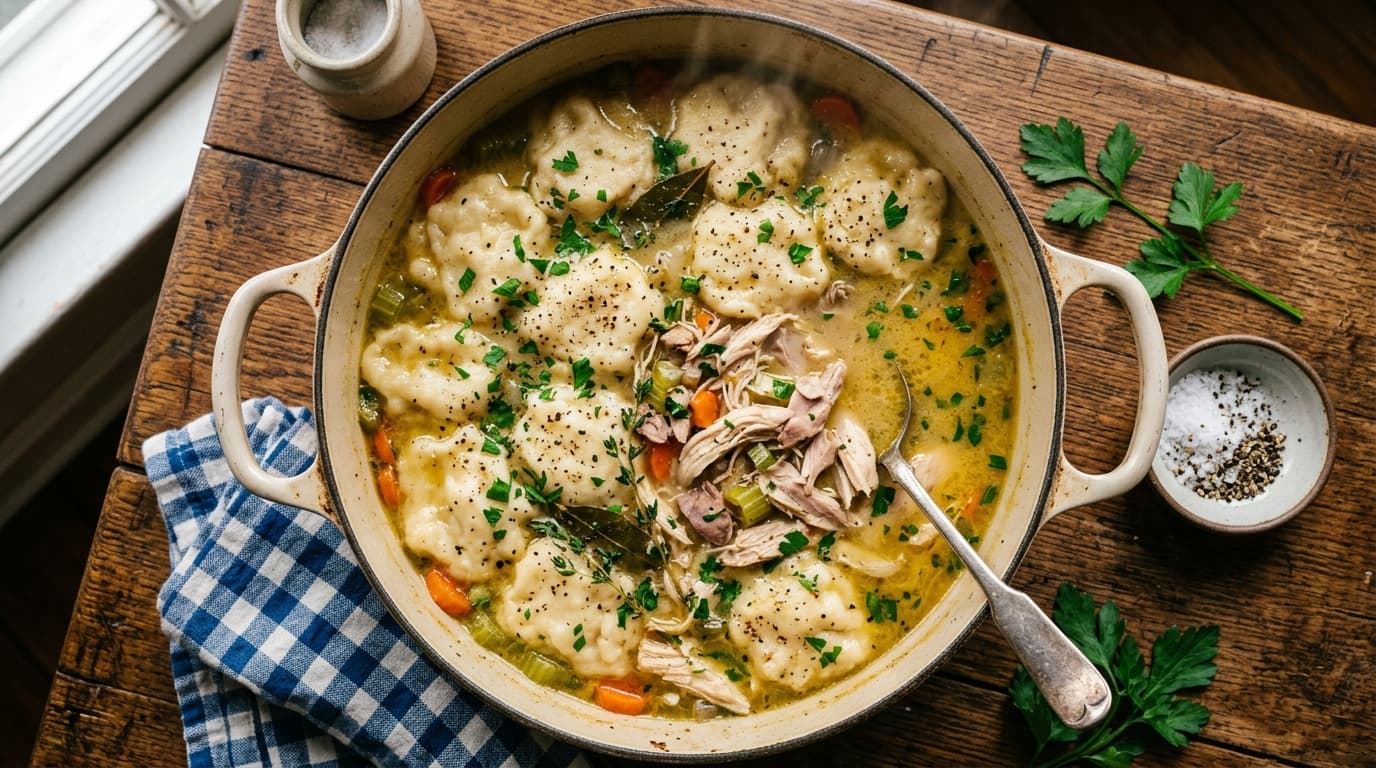
Southern Chicken and Dumplings
Whole chicken simmered into a rich, golden homemade bone broth with carrots and celery, loaded with tender rolled flat pastry dumplings that thicken the stew into velvety comfort food.
Macro Nutrition Profile (Per Serving)
Ingredients
Whole Chicken & Rich Golden Stock
The Rolled Flat Dumplings (Slickers)
Finishing the Stew
Ingredient Substitutions
| Original Ingredient | Healthy Alternative |
|---|---|
| Chicken breast | Turkey breast or extra-firm tofu (1:1 ratio) |
| Dino kale/greens | Baby spinach or Swiss chard (cooks faster, add at the end) |
Instructions
Simmer the Whole Chicken Stock: Place a 4 1/2 to 5-pound cut-up whole chicken into a large heavy Dutch oven or stockpot. Add 10 cups of cold water, ensuring the chicken pieces are submerged. Add 2 quartered yellow onions, 1 chopped carrot, 1 chopped celery stalk (with leafy tops), 5 smashed garlic cloves, 2 bay leaves, 4 thyme sprigs, 4 parsley sprigs, 1 tablespoon of kosher salt, and 1 teaspoon of whole black peppercorns. Bring to a boil over medium-high heat. As foam and impurities rise to the surface during the first 10 minutes, skim them off with a wide spoon and discard. Reduce heat to medium-low, cover partially with the lid, and simmer gently for 55 to 65 minutes, until the chicken meat is tender and easily separates from the bone.
Strain the Broth and Shred the Meat: Use tongs to transfer the cooked chicken pieces to a large rimmed baking sheet. Let cool for 15 minutes until safe to handle. Discard the chicken skin and bones; shred or pull the warm white and dark meat into bite-sized chunks. Cover the meat with a sheet of foil to keep it moist. Pour the contents of the pot through a fine-mesh sieve set over a large heatproof bowl. Press gently on the spent vegetables and aromatics to extract remaining liquid, then discard the solids. Skim excess clear yellow fat from the top of the strained broth, reserving 2 tablespoons of this flavorful chicken fat. You should have roughly 7 to 8 cups of rich, golden broth. Return the strained broth to the Dutch oven and place over low heat.
Mix the Rolled Dumpling Dough: In a large mixing bowl, whisk together 2 cups of all-purpose flour, 1 teaspoon of baking powder, and 1 teaspoon of fine sea salt. Add 4 tablespoons of cold unsalted butter (cut into small cubes) or shortening. Use a pastry blender, two forks, or your fingertips to work the fat into the dry flour until the mixture resembles coarse meal with pea-sized crumbs. Make a well in the center of the flour. Pour in 3/4 cup of warm chicken broth (ladled directly from the pot) or whole milk. Stir with a wooden spoon just until a shaggy, cohesive dough comes together. If the dough feels too dry, add an extra tablespoon of warm broth. Do not over-knead.
Roll, Cut, and Rest the Dumplings: Generously dust a clean wooden cutting board or countertop with all-purpose flour. Turn the dough out and press it into a flat disc. Dust the top of the dough and your rolling pin with flour. Roll the dough out firmly from the center toward the edges until it is roughly 1/8-inch thick (uniform thickness is key so all dumplings cook at an identical rate). Using a sharp chef's knife or a pizza cutting wheel, slice the rolled dough into long strips roughly 1 1/2 inches wide. Then crosscut the strips every 2 1/2 to 3 inches to form rectangular dumplings. Dust the cut dumplings generously with extra flour so they do not stick together. Let the cut dumplings rest undisturbed on the floured counter for 15 to 20 minutes to air-dry and set their exterior surface.
Build the Stew Base: While the dumplings dry, bring the strained golden broth in the Dutch oven to a steady simmer over medium heat. Add 2 sliced carrots, 2 sliced stalks of celery, 1/2 teaspoon of freshly cracked black pepper, and 1/4 teaspoon of dried poultry seasoning (or rubbed sage). Simmer for 8 to 10 minutes until the vegetables begin to soften.
Drop and Simmer the Dumplings: Ensure the broth is at a steady, active simmer (bubbles breaking the surface continuously, but not a violent rolling boil). Pick up the dried dumpling strips one at a time, gently shaking off excess loose flour (retain the flour coating that clings to the surface), and drop them directly into the simmering broth across different areas of the pot. Do not stir with a spoon, as stirring will tear the delicate, uncooked dough. Instead, use the back of a large metal spoon to press down gently on the dumplings, submerging them beneath the liquid. Once all dumplings are dropped into the pot, reduce the heat to low. Cover the Dutch oven tightly with its heavy lid. Simmer covered undisturbed for 15 to 18 minutes. The trapped steam cooks the dumplings through to a pillowy, tender chew, while the flour dissolves to thicken the broth into a velvety gravy.
Fold in the Chicken and Finish: Remove the lid. Stir in 1/2 cup of heavy cream (if using) and gently fold in the shredded cooked chicken meat. Simmer uncovered over low heat for 3 to 4 minutes, just until the chicken is heated through and the gravy has reached a rich, creamy consistency. Taste the gravy and adjust seasoning with additional kosher salt and coarse black pepper.
Garnish and Serve: Ladle the steaming chicken, vegetables, and tender rolled dumplings into wide, shallow bowls. Scatter finely chopped fresh flat-leaf parsley over the top. Serve hot with warm buttermilk biscuits or skillet cornbread.
The Smoked Chicken and Bacon Dumpling Stew: Use shredded meat from a hickory-smoked whole chicken. Render 4 strips of chopped bacon in the Dutch oven before adding the broth. The gentle woodsmoke flavor pairs naturally with the sweet carrots and tender dumplings.
The Herbed Dumpling Dough: Whisk 1 tablespoon of finely chopped fresh chives, 1 teaspoon of minced fresh thyme, and 1/2 teaspoon of cracked black pepper directly into the dry flour before working in the butter. The green herb flecks produce visually striking dumplings with herbaceous aromatics.
The Quick Weeknight Rotisserie Hack: When short on time, simmer 8 cups of quality low-sodium chicken bone broth with shredded rotisserie chicken, sliced vegetables, and fresh herbs for 20 minutes. Prepare the rolled scratch dumplings as directed and simmer directly in the enriched broth.
Soft Winter Wheat vs. Hard Spring Wheat: Southern Bleached/Unbleached Soft Wheat Flour (White Lily Style): Traditional Southern bakers swear by soft winter wheat flours. These flours contain between 8% and 9% protein, compared to 11% to 12% protein in standard national all-purpose flours. The lower protein content limits gluten development when the dough is rolled out, producing dumplings with a silky, delicate, melt-in-the-mouth chew. Standard All-Purpose Flour: If using national brand all-purpose flour, avoid overworking the dough. Roll it out gently and let it rest so the gluten fibers relax before hitting the hot broth.
The Leavening Debate: Flat Pastry vs. Light Puffed Strips: Traditional farm-style "slickers" frequently omit baking powder entirely, relying only on flour, salt, fat, and broth. This yields an ultra-dense, chewy, noodle-like ribbon that holds up to vigorous simmering. Adding a conservative 1 teaspoon of baking powder (as in this recipe) introduces micro-bubbles of carbon dioxide gas during the simmer. This lightens the dumpling slightly without turning it into a puffy drop biscuit, achieving the ideal balance of chew and tenderness.
The Dumplings Disintegrated into Muddy Slurry: The Cause: The dough was either rolled too thin, dropped into a violent rolling boil, or stirred aggressively with a spoon. The Solution: Keep the rolled dough at a solid 1/8-inch thickness. Let the cut dumplings rest on the floured counter for 15 minutes to form a protective dry skin. Keep the broth at a low, gentle simmer and never stir with a spoon—use the flat back of a spoon to gently submerge them.
The Stew is Thin and Watery Like Soup: The Cause: Excess flour was shaken off the dumplings before dropping them into the pot, or the stew was not allowed to simmer covered for the full 15 minutes. The Solution: The loose flour clinging to the dumplings is the thickening agent. Allow that flour to dissolve into the simmering broth, and ensure the lid stays on so trapped steam gelatinizes the starches completely.
The Dumplings Are Gummy and Doughy in the Center: The Cause: Dumplings were rolled too thick (over 1/4 inch) or the pot was removed from heat before the starches cooked through. The Solution: Roll the dough evenly to 1/8 inch. Cook covered on low heat for at least 15 to 18 minutes; test one dumpling by cutting it in half—it should look uniform in color throughout without a pasty, white core.
Tried this recipe?
Let us know how it turned out! Click a star below to leave a review and rate the recipe.
Storage & Freezing Tips
- Refrigerator: Store leftovers in an airtight container for up to 3-4 days.
- Reheating: Heat in a saucepan or skillet on medium heat until hot throughout.
- Freezing: Freeze portions in airtight containers for up to 2 months. Reheat directly from frozen or after thawing.
Frequently Asked Questions
Can this recipe be prepared ahead of time?▼
Yes, this meal is excellent for weekly meal prep. Store components separately and assemble before serving.
Is this recipe gluten-free?▼
All ingredients used are naturally gluten-free. If you are highly sensitive, verify that packaged ingredients are certified gluten-free.
Tried this recipe?
Tag @stewartlucas on Instagram and hashtag it #nutriguide!
You Might Also Like

Stewart Lucas
Nutritionist & Recipe DeveloperStewart Lucas is a nutritionist and recipe developer representing the NutriGuide team. All recipes, nutritional values, and diet protocols published on this site are designed and audited by certified dietitians and clinical nutrition professionals to guarantee absolute accuracy.
Community Reviews
Please log in to leave a review.