Baked Lemon Salmon (Herb & Butter Sheet Pan Masterclass)
The definitive sheet-pan masterclass for tender Baked Lemon Salmon with garlic-herb compound butter and roasted asparagus. Master thermal radiant roasting, protective citrus shielding, albumin mitigation, and synchronous vegetable cooking in 20 minutes.
Key Takeaways
- ✓Compound herb butter acts as a sacrificial lipid blanket, melting progressively during baking to seal in moisture and prevent protein evaporation.
- ✓Laying thin lemon wheels across the crown creates a radiant thermal shield that prevents the delicate upper salmon flesh from drying out under oven heat.
- ✓Bake at 400�F (204�C) for 12 to 14 minutes until the internal core thermometer registers 125�F-128�F; carryover heat will carry it to a silky 132�F.
- ✓Synchronize your side dish: 1/2-inch fresh asparagus spears roasted on the same parchment sheet pan reach vibrant tender-crispness at the exact same minute as the salmon.
- ✓A 60-second flash broil at the very end caramelizes the lemon wheels and crisps the herb butter capers without compromising interior flakiness.
The Story
Sheet pan baked salmon is the undisputed monarch of contemporary weeknight home cooking, embodying the modern culinary quest for effortless elegance, minimal cleanup, and nutrient-dense vitality. The technique has its roots in Scandinavian and Mediterranean oven-baking traditions, where whole sides of cold-water sea fish were laid on stone slabs draped with wild sea herbs, fresh citrus slices, and cultured country butter before entering wood-fired hearths.
However, the modern sheet pan movement has suffered from oversimplification. Far too many published recipes instruct home cooks to toss naked salmon fillets onto a cold, unlined metal baking sheet alongside random root vegetables, crank the oven to 450�F, and bake for twenty-five minutes. The predictable outcome is culinary tragedy: the delicate fish expels white albumin proteins in distress, the underside scorches against bare metal, the upper flesh becomes chalky and dry, and the accompanying vegetables emerge either burnt or unpleasantly fibrous.
This masterclass elevates sheet pan salmon into an exact, reproducible science. By exploring the thermal physics of radiant versus conductive heat transfer, deploying an aromatic compound butter lipid shield, and leveraging the natural geometry of citrus fruit disks to modulate oven thermodynamics, you will produce restaurant-quality, buttery salmon fillets accompanied by crisp-tender asparagus on a single sheet pan in less than twenty minutes.
The Science of Flavor Chemistry & Thermal Dynamics
Achieving silkiness in an oven requires mastering radiant thermal convection, moisture barriers, and vegetable thermodynamics.
1. The Physics of Radiant Oven Roasting vs. Conduction
In stovetop pan-searing, heat transfer occurs primarily via conduction�direct kinetic energy transfer from the hot metal surface to the food. This is ideal for fast searing but creates steep temperature gradients between the exterior crust and the interior core.In an oven, heat transfer occurs through a combination of radiation (infrared energy emitted by hot oven walls) and natural convection (currents of heated air circulating around the food). Because air has a thermal conductivity roughly 25 times lower than water and hundreds of times lower than iron, heat transfers into the food gently and uniformly from all angles. Baking salmon on a sheet pan lined with unbleached parchment paper moderates the conductive heat from the metal pan floor, ensuring the underside of the fish cooks at the exact same rate as the top.
2. The Compound Butter Lipid Shield
Salmon muscle tissue is approximately 68-72% water. In the dry microclimate of a hot 400�F convection oven, water molecules on the surface of the fish undergo rapid vaporization, drawing heat and leaving the outer muscle fibers parched and stringy.To halt this moisture loss, we apply an emulsified compound butter blanket directly onto the flesh before baking. Butter consists of approximately 82% hydrophobic butterfat. As the salmon enters the oven, the butter softens and melts across the myotomes, forming a protective, non-polar lipid envelope. This oil barrier acts as a physical shield against evaporation: moisture attempting to escape the fish is trapped beneath the butter layer, essentially braising the upper surface in its own savory juices infused with fresh garlic, dill, parsley, and tarragon.
3. Thermal Citrus Shielding: The Lemon Wheel Mechanism
A common question asked by home cooks is whether sliced lemon wheels placed atop salmon are merely decorative. In high-level culinary physics, they serve an indispensable thermodynamic function.Lemons consist of roughly 89% water and possess high specific heat capacity. When thin lemon wheels (approximately 1/8-inch thick) are arranged in an overlapping pattern down the spine of the salmon, they absorb the aggressive direct infrared radiation from the upper oven heating element. Instead of radiant heat scorching the delicate salmon flesh, that energy vaporizes the citric acid and essential limonene oils contained in the lemon's juice sacs and flavedo peel. This generates a localized micro-climate of citrus steam, gently infusing the fish while preventing surface desiccation.
4. Vegetable Thermodynamics & Synchronized Roasting
A recurring flaw in sheet pan recipes is pairing ingredients with mismatched thermal kinetics. If you place dense potatoes or whole carrots on the same sheet pan with salmon, the salmon will be ruined before the vegetables soften.Fresh medium asparagus spears (approximately 1/2-inch in diameter) are biologically ideal partners for salmon. Asparagus stalks consist primarily of water and cellulose fibers that undergo thermal tenderization between 180�F and 200�F (82�C to 93�C). When tossed in extra virgin olive oil and roasted at 400�F (204�C), asparagus requires precisely 12 to 14 minutes to transition from rigid to vibrant, crisp-tender�the exact duration required for a 2-pound side of salmon to reach 125�F internal temperature. Both finish in absolute synchrony.
Essential Equipment & Thermal Calibration
Essential tools for executing this sheet pan masterpiece:
- Heavy-Duty Half-Sheet Baking Pan (18x13 inches): Constructed from 18-gauge commercial aluminum. Cheap, flimsy baking sheets warp and buckle under oven heat, causing melted butter to pool in one corner and cook unevenly. A heavy commercial sheet pan ensures rigid flatness and uniform heat dispersion.
- Unbleached Heavy-Duty Parchment Paper: Parchment paper creates a non-stick silicone barrier that prevents delicate salmon skin from adhering to the pan, eliminates scorching, and makes cleanup as simple as discarding the paper.
- Instant-Read Digital Thermometer: To eliminate guesswork by verifying when the salmon core hits the 125�F-128�F sweet spot.
- Mandoline or Ultra-Sharp Chef�s Knife: To slice the organic lemons into paper-thin, uniform wheels that cook and caramelize evenly without releasing bitter pith juice.
Anatomy of the Ingredients & Artisanal Sourcing
The sensory triumph of this recipe hinges upon pristine ingredient quality:
- Whole Side of Atlantic or King Salmon (2 lbs): Using a whole side of salmon rather than pre-cut small fillets offers significant culinary advantages. A large, continuous fillet has greater thermal mass, reducing the rate of internal temperature rise and providing a much wider margin of error against overcooking. The thick loin stays luscious and medium-rare, while the thinner belly and tail edges develop delightful crispy roasted texture. Ensure the fishmonger has scaled the skin and checked for pin bones.
- Fresh Medium Asparagus: Look for firm, bright green spears with tightly closed, purple-tinged tips. Avoid thick, woody stalks (which take too long to cook) or pencil-thin spears (which turn to mush in 8 minutes). Snapping the woody fibrous bottom 1.5 inches off by hand naturally breaks the stalk at the tender transition point.
- European Unsalted Butter (82% Butterfat): The higher fat content ensures the compound butter stays rich and creamy rather than separating into watery residue during the baking cycle.
Step-by-Step Culinary Masterclass
Step 1: Preheat Oven & Sheet Pan Preparation
Position an oven rack in the center position and preheat the oven to 400�F (204�C) on standard bake mode (or 385�F convection bake). Line a heavy-duty 18x13-inch commercial half-sheet pan with unbleached parchment paper, allowing a slight 1-inch overhang along the edges to catch melting butter. Snap the woody bottom ends off the asparagus spears; discard ends.
- Chef's Technique Tip: Ensure your oven is thoroughly preheated for at least 20 minutes so the interior radiant walls are fully saturated with heat.
- Sensory Checkpoint: The oven thermometer reads a stable 400�F and the parchment lies flat on the clean sheet pan.
Step 2: Crafting the Artisanal Herb Compound Butter
In a medium mixing bowl, combine the 6 tablespoons of softened room-temperature European butter, 5 cloves of finely grated fresh garlic, 2 tablespoons of minced fresh dill, 2 tablespoons of chopped Italian flat-leaf parsley, 1 tablespoon of minced tarragon, 1 teaspoon of fresh lemon zest, 1/2 teaspoon of Kosher salt, and 1/4 teaspoon of black pepper. Using a fork or small rubber spatula, mash and blend the ingredients until a vibrant, speckled, fragrant green compound butter forms.
- Chef's Technique Tip: Softened room-temperature butter is essential; if the butter is too cold, it will tear the delicate raw salmon flesh when spreading.
- Sensory Checkpoint: A smooth, spreadable herb-studded butter with an intoxicating aroma of garlic, citrus, and fresh herbs.
Step 3: Salmon Pre-Brining & Arrangement
Lay the side of salmon skin-side down in the center of the parchment-lined sheet pan. Sprinkle the flesh with 1 teaspoon of Kosher salt and 1/2 teaspoon of freshly cracked black pepper. Allow to sit at room temperature for 10 minutes. Blot any extruded moisture dry with paper towels. Using an offset spatula or the back of a spoon, spread the herb compound butter in an even, luxurious layer across the entire top surface of the salmon.
- Chef's Technique Tip: The thin dry-brining step is non-negotiable for preventing unsightly white albumin protein leakage.
- Sensory Checkpoint: The salmon is evenly blanketed with the fragrant green compound butter from end to end.
Step 4: Citrus Shielding & Asparagus Setup
Arrange the thin lemon wheels down the spine of the salmon in a slightly overlapping shingles pattern. Scatter the 2 tablespoons of drained capers evenly over the butter and lemon wheels. Arrange the prepared asparagus spears on both sides of the salmon in a single layer. Drizzle the asparagus with 1.5 tablespoons of extra virgin olive oil, season with a pinch of salt and pepper, and toss lightly on the parchment to coat.
- Chef's Technique Tip: Overlapping the lemon wheels creates the continuous citrus steam-shield that protects the thickest part of the fillet.
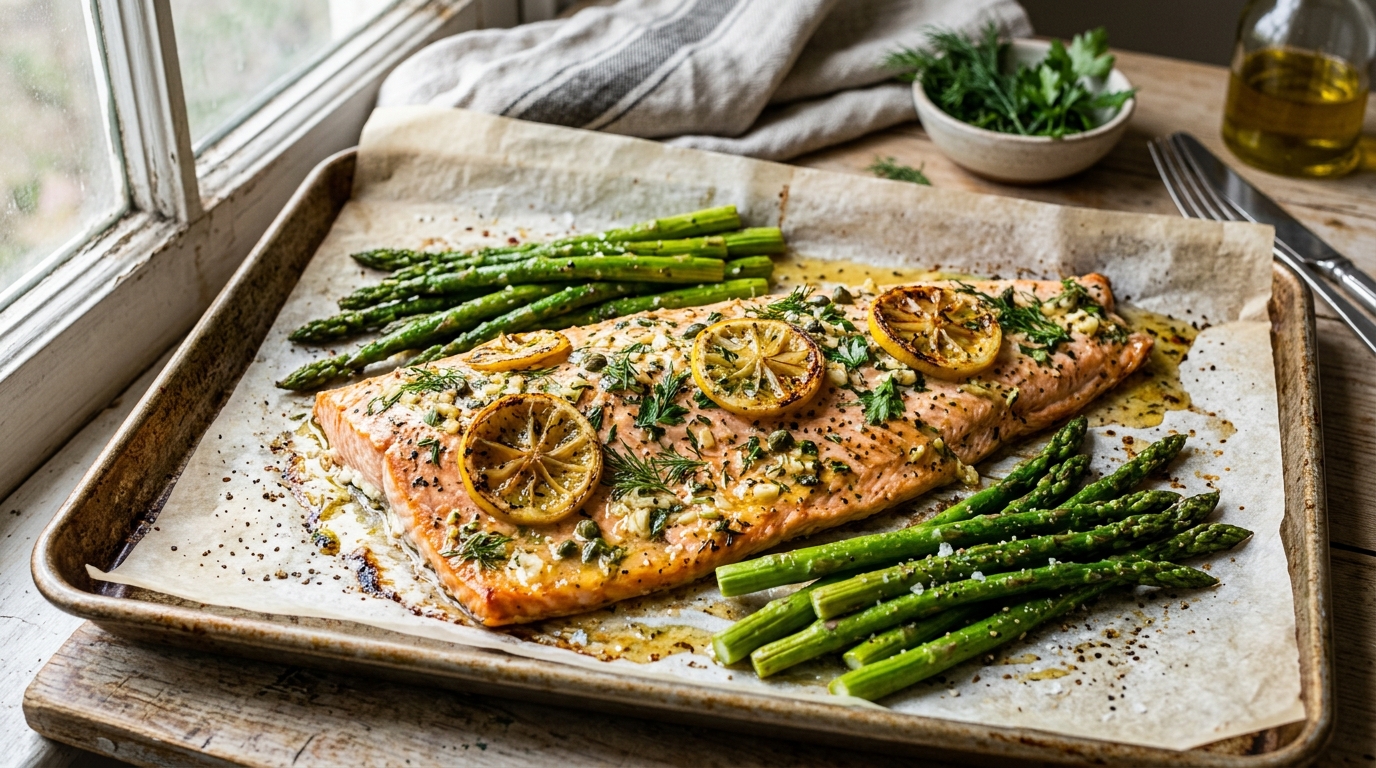
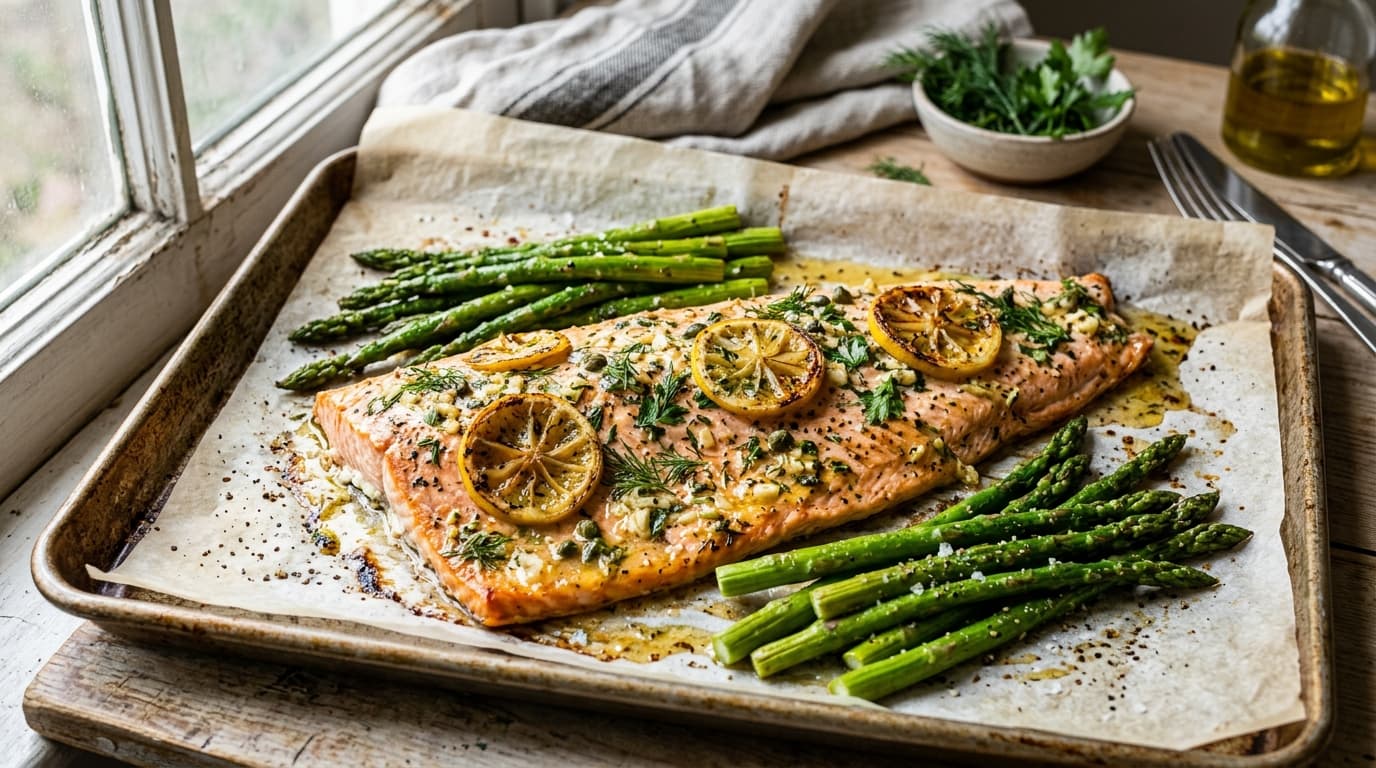
- Sensory Checkpoint: A visually stunning sheet pan layout: vibrant orange salmon crown draped in yellow lemon wheels and green herbs, flanked by bright green asparagus.
Step 5: Precision Oven Baking
Slide the sheet pan into the center rack of the 400�F oven. Bake undisturbed for 12 to 14 minutes. As it bakes, the compound butter will melt, cascading over the salmon sides and mingling with the lemon juices and caper brine to create an unctuous roasting liquid that simultaneously coats the asparagus. At the 12-minute mark, insert an instant-read digital thermometer into the thickest center of the salmon. When it registers 125�F to 128�F (52�C to 53�C), the salmon is done.
- Chef's Technique Tip: Do not exceed 130�F in the oven; residual carryover heat during resting will easily bring the core to the ideal 132�F silky flake state.
- Sensory Checkpoint: The salmon flesh is opaque and tender, the herb butter is bubbling gently on the parchment, and the asparagus is bright green and tender-crisp.
Step 6: Optional 60-Second Flash Broil, Resting & Plating
Optional: Switch the oven to HIGH BROIL for the final 60 seconds to slightly caramelize the lemon wheels and crisp the capers (watch closely to prevent burning!). Remove the sheet pan from the oven. Squeeze 1 to 2 tablespoons of fresh lemon juice over the hot salmon and asparagus. Allow the salmon to rest on the sheet pan for 5 minutes to let muscle fibers relax and reabsorb juices. Spoon the warm melted herb butter pan drippings generously over the salmon and asparagus. Garnish with fresh dill sprigs and serve immediately.
- Chef's Technique Tip: The 5-minute rest allows the melted butter and natural juices to settle into the flake crevices rather than running out when cut.
- Sensory Checkpoint: Caramelized edges on lemon wheels, glistening buttery flakes that separate with a fork, and vibrant, tender asparagus.
Pro-Chef Troubleshooting & Critical Checkpoints
Problem: The Salmon Developed Unsightly White Curd (Albumin) on Top
- The Root Cause: The salmon was baked too long, cooked from ice-cold refrigerator temperature, or baked without the 10-minute dry brine pre-treatment.
- The Masterclass Solution: Always dry-brine with salt for 10 minutes at room temperature before spreading butter, and pull the salmon at 125�F-128�F internal temperature.
Problem: The Asparagus is Limp, Soggy, and Drab Olive Green
- The Root Cause: Pencil-thin asparagus was used, or the vegetables were overcrowded and steamed in excess liquid rather than roasting.
- The Masterclass Solution: Use medium 1/2-inch spears, ensure they are spread in a single uncrowded layer, and avoid dumping excess liquid onto the vegetable zone.
Problem: The Underside of the Salmon Scorched or Stuck
- The Root Cause: Salmon was placed directly on an unlined bare metal sheet pan without parchment paper, causing excessive conductive heat transfer.
- The Masterclass Solution: Always line your sheet pan with heavy-duty parchment paper. The silicone barrier insulates the bottom and guarantees effortless release.
Problem: The Lemon Wheels Taste Bitter
- The Root Cause: Lemons were sliced too thick with excessive bitter white pith, or seeds were left embedded in the fruit.
- The Masterclass Solution: Slice lemons thinly (1/8-inch) with a sharp knife and flick away all seeds before shingling across the salmon.
Problem: The Center of the Salmon is Still Cold While the Tail is Overcooked
- The Root Cause: The salmon was placed in the oven straight from the cold refrigerator, and the thin tail was not tucked under.
- The Masterclass Solution: Bring the fish to cool room temperature for 15 minutes prior to baking, and fold the thin tail end under itself to create uniform thickness throughout.
Macro Analysis & Nutritional Optimization
Baked lemon salmon with asparagus represents the gold standard of Mediterranean lifestyle nutrition:
- Superior Omega-3 Index Enhancement: A single 6-ounce portion of roasted Atlantic salmon delivers over 2,200 mg of combined EPA and DHA omega-3 fatty acids, actively lowering serum triglyceride concentrations, decreasing systemic inflammatory cytokines (TNF-alpha, IL-6), and supporting neuronal membrane fluidity.
- Potent Natural Diuretic & Folate Source: Asparagus contains the amino acid asparagine, which functions as a natural, gentle diuretic supporting renal fluid balance, while providing over 60% of the daily value of bioavailable Vitamin B9 (folate) critical for cellular methylation pathways.
- Glutathione & Selenium Cellular Defense: Pairing selenium-dense wild seafood with the natural glutathione found in fresh asparagus provides unmatched support for Phase II hepatic detoxification enzymes.
Artisanal Serving & Pairing Architecture
This bright, buttery, citrus-infused entr�e pairs wonderfully with refreshing, acid-driven accompaniments:
- Starch & Grain Companions:
- Wine Selections:
- Salad Pairing: Shaved cucumber and red onion ribbon salad with white balsamic and mint.
Scientific Storage, Meal Prep & Reheating Protocol
Preserve the delicate moisture and aromatics of baked salmon:
- Refrigeration: Let leftovers cool for 30 minutes. Transfer the salmon and asparagus into airtight glass meal prep containers. Drizzle any remaining sheet pan herb butter juices over the top. Seal and refrigerate at 35�F-38�F (2�C-3�C) for up to 3 days.
- Gentle Oven Reheating Protocol: Preheat your oven or toaster oven to 275�F (135�C). Place the salmon and asparagus on a parchment-lined baking sheet. Cover tightly with aluminum foil to prevent moisture from evaporating into the oven. Warm for 10 to 12 minutes until the core reaches 120�F.
- Cold Repurposing Ideas: Chilled baked lemon salmon is exquisite flaked over a Mediterranean grain bowl with feta, kalamata olives, and tzatziki; mixed with Greek yogurt, capers, and dill for a gourmet salmon salad sandwich; or served atop crisp salad greens with a lemon-herb vinaigrette.
Frequently Asked Questions (Masterclass Edition)
Q: Can I use salmon fillets instead of a whole side of salmon?
A: Yes! Use 4 individual 6-8 oz center-cut fillets. Arrange them with 1 inch of space between each piece on the sheet pan, spread the herb butter and lemon wheels over each, and bake at 400�F for 10 to 12 minutes (individual fillets cook 2 minutes faster than a whole side).Q: Can I use frozen salmon for this recipe?
A: Yes, provided the salmon is completely thawed before cooking. Thaw frozen vacuum-sealed fillets overnight in the refrigerator. Thoroughly blot away all surface moisture with paper towels before seasoning and buttering. Never attempt to bake frozen salmon directly on a sheet pan, as it will release immense water and boil.Q: Can I swap the asparagus for another vegetable?
A: Yes! Tender broccolini florets, green beans, or halved zucchini slices cook in the same 12-14 minute window. If you wish to use denser vegetables like baby potatoes or carrots, roast them alone for 15 minutes first before adding the salmon and asparagus to the sheet pan.Q: What if I don't have fresh tarragon?
A: Tarragon can be replaced with fresh chives, fresh basil, or an equal additional amount of fresh dill. Fresh herbs are strongly preferred over dried for this compound butter.Q: How do I ensure the skin comes off easily if I don't want to eat it?
A: Baking the salmon skin-side down on parchment paper is a pro-chef trick: when the salmon is done and rested, simply slide your thin fish spatula between the flesh and the skin. The skin will stick firmly to the parchment paper, allowing you to lift away pristine, skinless fillets effortlessly.Baked Lemon Salmon (Herb & Butter Sheet Pan Masterclass)
The definitive sheet-pan masterclass for tender Baked Lemon Salmon with garlic-herb compound butter and roasted asparagus. Master thermal radiant roasting, protective citrus shielding, albumin mitigation, and synchronous vegetable cooking in 20 minutes.
Macro Nutrition Profile (Per Serving)
Ingredients
Ingredient Substitutions
| Original Ingredient | Healthy Alternative |
|---|---|
| Salmon/Cod | Steelhead trout, halibut, or sea bass (baking times may vary) |
| Asparagus/Veg | Zucchini slices, broccoli florets, or green beans (roast at same temperature) |
Instructions
Preheat Oven & Sheet Pan Preparation: Position an oven rack in the center position and preheat the oven to 400�F (204�C) on standard bake mode (or 385�F convection bake). Line a heavy-duty 18x13-inch commercial half-sheet pan with unbleached parchment paper, allowing a slight 1-inch overhang along the edges to catch melting butter. Snap the woody bottom ends off the asparagus spears; discard ends. Chef's Technique Tip: Ensure your oven is thoroughly preheated for at least 20 minutes so the interior radiant walls are fully saturated with heat. Sensory Checkpoint: The oven thermometer reads a stable 400�F and the parchment lies flat on the clean sheet pan.
Crafting the Artisanal Herb Compound Butter: In a medium mixing bowl, combine the 6 tablespoons of softened room-temperature European butter, 5 cloves of finely grated fresh garlic, 2 tablespoons of minced fresh dill, 2 tablespoons of chopped Italian flat-leaf parsley, 1 tablespoon of minced tarragon, 1 teaspoon of fresh lemon zest, 1/2 teaspoon of Kosher salt, and 1/4 teaspoon of black pepper. Using a fork or small rubber spatula, mash and blend the ingredients until a vibrant, speckled, fragrant green compound butter forms. Chef's Technique Tip: Softened room-temperature butter is essential; if the butter is too cold, it will tear the delicate raw salmon flesh when spreading. Sensory Checkpoint: A smooth, spreadable herb-studded butter with an intoxicating aroma of garlic, citrus, and fresh herbs.
Salmon Pre-Brining & Arrangement: Lay the side of salmon skin-side down in the center of the parchment-lined sheet pan. Sprinkle the flesh with 1 teaspoon of Kosher salt and 1/2 teaspoon of freshly cracked black pepper. Allow to sit at room temperature for 10 minutes. Blot any extruded moisture dry with paper towels. Using an offset spatula or the back of a spoon, spread the herb compound butter in an even, luxurious layer across the entire top surface of the salmon. Chef's Technique Tip: The thin dry-brining step is non-negotiable for preventing unsightly white albumin protein leakage. Sensory Checkpoint: The salmon is evenly blanketed with the fragrant green compound butter from end to end.
Citrus Shielding & Asparagus Setup: Arrange the thin lemon wheels down the spine of the salmon in a slightly overlapping shingles pattern. Scatter the 2 tablespoons of drained capers evenly over the butter and lemon wheels. Arrange the prepared asparagus spears on both sides of the salmon in a single layer. Drizzle the asparagus with 1.5 tablespoons of extra virgin olive oil, season with a pinch of salt and pepper, and toss lightly on the parchment to coat. Chef's Technique Tip: Overlapping the lemon wheels creates the continuous citrus steam-shield that protects the thickest part of the fillet. Sensory Checkpoint: A visually stunning sheet pan layout: vibrant orange salmon crown draped in yellow lemon wheels and green herbs, flanked by bright green asparagus.
Precision Oven Baking: Slide the sheet pan into the center rack of the 400�F oven. Bake undisturbed for 12 to 14 minutes. As it bakes, the compound butter will melt, cascading over the salmon sides and mingling with the lemon juices and caper brine to create an unctuous roasting liquid that simultaneously coats the asparagus. At the 12-minute mark, insert an instant-read digital thermometer into the thickest center of the salmon. When it registers 125�F to 128�F (52�C to 53�C), the salmon is done. Chef's Technique Tip: Do not exceed 130�F in the oven; residual carryover heat during resting will easily bring the core to the ideal 132�F silky flake state. Sensory Checkpoint: The salmon flesh is opaque and tender, the herb butter is bubbling gently on the parchment, and the asparagus is bright green and tender-crisp.
Optional 60-Second Flash Broil, Resting & Plating: Optional: Switch the oven to HIGH BROIL for the final 60 seconds to slightly caramelize the lemon wheels and crisp the capers (watch closely to prevent burning!). Remove the sheet pan from the oven. Squeeze 1 to 2 tablespoons of fresh lemon juice over the hot salmon and asparagus. Allow the salmon to rest on the sheet pan for 5 minutes to let muscle fibers relax and reabsorb juices. Spoon the warm melted herb butter pan drippings generously over the salmon and asparagus. Garnish with fresh dill sprigs and serve immediately. Chef's Technique Tip: The 5-minute rest allows the melted butter and natural juices to settle into the flake crevices rather than running out when cut. Sensory Checkpoint: Caramelized edges on lemon wheels, glistening buttery flakes that separate with a fork, and vibrant, tender asparagus.
Tried this recipe?
Let us know how it turned out! Click a star below to leave a review and rate the recipe.
Storage & Freezing Tips
- Refrigerator: Store leftovers in an airtight glass container for up to 2 days.
- Reheating: Warm gently in a skillet on medium-low heat with a lid to keep the fish tender. Avoid microwaving to prevent rubbery texture.
- Freezing: We do not recommend freezing cooked fish as it degrades the texture.
Frequently Asked Questions
How do I prevent the fish from sticking to the pan?▼
Ensure your baking dish is lightly oiled or lined with parchment paper, and make sure the oven is fully preheated before cooking.
Can I make this recipe with frozen fish?▼
Yes. Thaw the fish completely in the refrigerator overnight, then pat it dry thoroughly with a paper towel before adding seasonings.
Tried this recipe?
Tag @stewartlucas on Instagram and hashtag it #nutriguide!
You Might Also Like

Stewart Lucas
Nutritionist & Recipe DeveloperStewart Lucas is a nutritionist and recipe developer representing the NutriGuide team. All recipes, nutritional values, and diet protocols published on this site are designed and audited by certified dietitians and clinical nutrition professionals to guarantee absolute accuracy.
Community Reviews
Please log in to leave a review.