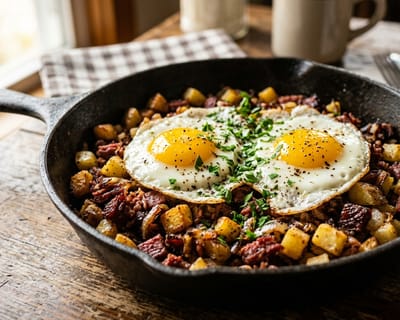
Corned Beef Hash with Eggs
Tender corned beef brisket and Yukon gold potatoes diced small, pan-crisped in seasoned cast iron with sweet caramelized onions, topped with sunny-side-up eggs featuring liquid golden yolks.
Key Takeaways
- ✓Ready in just 25 mins using straightforward, kitchen-tested technique.
- ✓Delivers 30g of muscle-fueling protein per serving for lasting satiety.
- ✓Portion-balanced at 490 calories per serving with wholesome, unrefined ingredients.
- ✓Masterclass temperature checkpoints ensure maximum tenderness and flavor development.
The Story
Corned beef hash stands as one of the great triumphs of thrift and morning cookery. Born out of the practical necessity to repurpose boiled Saint Patrick's Day brisket, Sunday roasts, and root vegetables, this humble diner classic proves that leftover meat can be transformed into something far superior to its original form.
A skillet of real homemade corned beef hash is worlds away from the salty, cat-food-textured paste found in tin cans. When properly prepared from cured whole brisket, buttery Yukon gold potatoes, and sweet caramelized onions, it delivers an intoxicating contrast: deeply browned, caramelized meat edges, tender creamy potato interiors, savory pickling spice aromatics, and the rich velvet of runny egg yolk washing over every forkful.
Yet, home cooks often struggle to achieve diner-counter perfection. The most common pitfalls are a soggy, steamed hash that refuses to brown, potatoes that turn to mush before the beef crisps, or a greasy, heavy pan with undercooked alliums. Mastering this dish requires understanding starch gelatinization, the physics of cast-iron heat transfer, and the chemistry of the Maillard reaction on cured beef.
The Origins and Evolution of Hash
The word hash derives from the French verb hacher, meaning "to chop" or "to mince." In seventeenth- and eighteenth-century European cookery, hashes were common methods for extending expensive roasted meats by mincing them with gravy, breadcrumbs, and root vegetables.
When Irish immigrants arrived in large numbers in American urban centers—particularly New York, Boston, and Chicago—during the mid-nineteenth century, they settled in close proximity to Jewish immigrant neighborhoods. Irish immigrants, who had eaten salt pork back home, discovered that cured beef brisket from kosher butcher shops was economical, flavorful, and closely mirrored traditional Irish boiled bacon.
The Irish-American tradition of the boiled corned beef and cabbage dinner became an annual ritual. But it was in classic 24-hour American railway diners that the leftover brisket found its ultimate destiny. Short-order line cooks minced the chilled brisket with boiled breakfast home fries and yellow onions, smashing the mixture flat against well-seasoned chrome flattops until a crisp, dark crust formed. Served with two over-easy eggs and hot buttered rye toast, corned beef hash cemented its place as an icon of American breakfast culture.
The Science of Achieving a Shatteringly Crisp Hash
Achieving a crisp hash is an exercise in moisture control and surface contact. Meat and potatoes are packed with water; if moisture cannot escape rapidly as steam, the ingredients poach in their own juices rather than fry.
1. Par-Boiling with an Alkaline Water Bath
Raw potatoes are roughly 80% water. If you drop raw diced potatoes into a skillet with corned beef, the potatoes take 20 minutes to soften. Long before the centers are cooked, the corned beef sugars and spices will burn to a bitter black char.The solution is a rapid par-boil in alkaline water:
- Cut the potatoes into precise 1/4-inch dice so they match the dimensions of the chopped meat.
- Bring a pot of water to a boil with 1 teaspoon of kosher salt and 1/2 teaspoon of baking soda (sodium bicarbonate).
- The alkaline environment gently dissolves the pectin on the exterior surface of each potato cube without softening the interior core.
- After 4 to 5 minutes, drain the potatoes and shake them vigorously in the colander. The agitated surface starches break down into a thin, starchy slurry. When this slurry hits hot rendered fat in the skillet, it dehydrates instantly, forming a micro-ridged crust of blistered crunchiness.
2. The Mechanics of Cast-Iron Heat Retention
Cast iron has a high volumetric heat capacity. Unlike thin aluminum nonstick pans, which drop 50 to 100 degrees the moment cold diced meat touches their surface, a heavy 12-inch cast-iron skillet stores abundant thermal energy. It maintains high, steady conductive heat, forcing immediate evaporation of surface water and initiating the Maillard reaction—the chemical reaction between amino acids and reducing sugars that produces rich pyrazines and browned savory depth.3. The "Smash and Wait" Protocol
The biggest error home cooks make is constant stirring. Stirring releases steam, cools down the cooking surface, and breaks fragile potato cubes into mush.To form a solid diner-style crust:
- Spread the hash evenly across the entire surface of the sizzling skillet.
- Press down firmly with the back of a wide metal spatula or burger smasher, compacting the ingredients into a cohesive, single-layer disc.
- Leave the heat on medium and do not touch the skillet for 6 to 8 minutes. You must allow the bottom crust to brown, dehydrate, and caramelize completely.
- When a deep, golden-brown crust has formed on the bottom, use the spatula to cut the hash into four large quadrants, flip each quadrant over, press down firmly again, and let the reverse side brown for another 5 to 6 minutes.
Selecting Your Ingredients
1. The Corned Beef: Point Cut vs. Flat Cut
- Point Cut (Deckle): The point cut features heavy intramuscular marbling, connective tissue, and a thicker fat cap. It is exceptionally juicy and yields the crispiest, most flavorful hash because the rendered beef tallow fries the potatoes from within.
- Flat Cut (Round): The flat cut is leaner and easier to slice into neat, uniform deli ribbons. If using leftover flat-cut corned beef, you will need to supplement the skillet with an extra tablespoon of butter, bacon fat, or beef tallow to ensure sufficient fat for frying.
- Texture Check: Always chill your cooked corned beef completely in the refrigerator before dicing. Cold fat and muscle fibers slice cleanly into sharp 1/4-inch cubes without shredding or tearing into stringy fibers.
2. The Potatoes: Yukon Gold
Yukon Gold potatoes strike the exact balance required for hash. Waxy red potatoes have too much moisture and too little surface starch, meaning they slide around the pan without crisping. Mealy Russet potatoes absorb water like sponges and fall apart into mashed potatoes when turned. Yukon Golds maintain their clean cubic geometry while their medium starch content builds a golden crust.3. The Alliums: Sweet Spanish or Yellow Onions
Onions provide natural fructose and sweet allium sulfur compounds that balance the heavy salt cure of the brisket. Dice the onions slightly smaller than the potatoes (around 1/8 to 1/4 inch) so they cook at an equal pace, melting into the crevices between the meat and potatoes.4. The Aromatics: Dijon, Worcestershire, and Warm Spices
Corned beef cured with standard pickling spices benefits from an extra hit of acidity and spice. Whisking 1 tablespoon of Worcestershire sauce with 1 teaspoon of Dijon mustard, 1/4 teaspoon of ground allspice, and freshly cracked black pepper introduces vinegar acidity, umami glutamates, and warm aromatics that slice cleanly through the rich beef fat.Step-by-Step Instructions
Follow these steps for classic, crisp corned beef hash:
Step 1: Dice the Chilled Brisket
Remove 3 cups (roughly 1 pound) of fully cooked, chilled corned beef brisket from the refrigerator. Using a sharp chef's knife, trim away any excessively thick exterior rubbery fat, leaving about 15% fat for flavor and browning. Slice the cold brisket against the grain into 1/4-inch slabs, then slice into 1/4-inch strips, and crosscut into neat 1/4-inch cubes. Keep chilled until ready to cook.Step 2: Par-Boil and Rough-Up the Potatoes
Peel 1 1/2 pounds of Yukon Gold potatoes and cut them into uniform 1/4-inch dice.Bring 2 quarts of water to a rolling boil in a medium pot over high heat. Stir in 1 teaspoon of kosher salt and 1/2 teaspoon of baking soda. Add the diced potatoes to the boiling water and cook for exactly 4 to 5 minutes, until you can pierce a cube with the tip of a paring knife with slight resistance (they must not be soft enough to mash).
Drain the potatoes thoroughly in a colander. Let them steam dry for 2 minutes, then shake the colander vigorously 4 or 5 times. You will see a cloudy, starchy film coat the edges of each cube. Set aside.
Step 3: Sauté the Onions and Aromatics
Place a heavy 12-inch seasoned cast-iron skillet over medium heat. Add 1 tablespoon of unsalted butter and 1 tablespoon of neutral oil or rendered bacon fat.Once the butter melts and foam subsides, add 1 1/2 cups of finely diced yellow onion. Cook for 5 to 6 minutes, stirring occasionally with a wooden spoon, until the onions are soft, translucent, and lightly golden around the edges. Add 2 cloves of finely minced garlic and cook for 60 seconds until fragrant.
Transfer the cooked onion-garlic mixture to a large mixing bowl.
Step 4: Combine the Hash Components
To the mixing bowl with the softened onions, add the par-boiled potatoes, diced cold corned beef, 1 tablespoon Worcestershire sauce, 1 teaspoon Dijon mustard, 1 teaspoon freshly cracked black pepper, 1/4 teaspoon ground allspice, 1/4 teaspoon smoked paprika, and 1/4 teaspoon kosher salt (taste a piece of cold beef first; if your brisket is heavily salted, omit added salt).Use a large rubber spatula to fold all ingredients together gently until the aromatics and seasoning are evenly dispersed.
Step 5: The High-Heat Smash and Sear
Turn the heat under the cast-iron skillet to medium-high. Add the remaining 2 tablespoons of butter and 1 tablespoon of oil or bacon fat. Swirl the pan to ensure the entire bottom and lower walls are slick with hot fat.Dump the entire bowl of hash into the sizzling skillet. It should sizzle immediately upon contact. Using a wide, stiff metal spatula or the flat bottom of a heavy small saucepan, press the hash down firmly and evenly across the skillet floor, compacting it into a solid, flat cake.
Reduce heat to medium. Cook undisturbed for 7 to 9 minutes. Do not stir, shake, or disturb the skillet. Listen to the sizzle: it should be steady and active. If you smell the slightest hint of scorching, turn the heat down slightly to medium-low.
After 7 minutes, use your metal spatula to gently lift an edge. You should see a deep mahogany, crackling crust.
Step 6: Flip and Crisp the Reverse Side
Using your metal spatula, cut the circular hash into four equal wedges. Slip the spatula completely under one quadrant and flip it over. Repeat with the remaining three quadrants. Some loose pieces will scatter—simply tuck them back in.Press the flipped hash down firmly again with your spatula. Cook undisturbed for another 5 to 7 minutes until the reverse side is equally golden, browned, and crisp throughout.
Step 7: Fry the Eggs
While the hash finishes its second crust, you have two options for the eggs:- Option A (Diner Skillet Method - Recommended): Use the back of a large spoon to press 4 deep wells or indentations into the top surface of the hash in the skillet. Crack one fresh egg into each well. Cover the skillet with a tight-fitting lid or a sheet of aluminum foil, reduce heat to low, and cook for 3 to 4 minutes until the egg whites are just opaque and set, but the yolks remain liquid and runny.
- Option B (Separate Basted Pan Method): In a separate nonstick skillet over medium-low heat, melt 1 tablespoon of butter. Fry 4 to 6 eggs sunny-side-up or over-easy until the whites are tender and the yolks are warm and fluid. Slide the fried eggs directly on top of the crisp hash.
Step 8: Garnish and Serve
Scatter 2 tablespoons of finely chopped flat-leaf parsley across the top of the skillet. Season the egg yolks with a pinch of flaky sea salt and coarse cracked black pepper.Bring the entire cast-iron skillet straight to the table. Serve immediately with warm buttered toast, pickled hot peppers, and a bottle of vinegar-based hot sauce or whole-grain mustard.
Pro-Tips for Maximum Crunch
- Chill the Cooked Brisket Overnight: Never attempt to make hash from freshly braised, warm corned beef. Warm brisket shreds into pulled meat threads that retain moisture and turn chewy. Chilling solidifies the beef tallow, allowing you to cut crisp, clean cubes.
- Do Not Skimp on Fat: Cast-iron frying requires sufficient lipid medium to transfer thermal energy evenly into every potato crevice. The combination of butter (for milk solid browning and rich aroma) and oil or beef tallow (for high smoke point) produces the crispiest results.
- Use a Metal Fish Spatula: A thin, flexible metal spatula can slide cleanly underneath the crust without tearing the delicate browned layer away from the potatoes.
Flavor Variations and Add-Ins
Storage, Freezing, and Reheating Science
Hash reheats better than almost any other breakfast potato dish, provided it is revived with dry heat.
Refrigerator Storage
Store leftover hash (without eggs) in an airtight glass container in the refrigerator for up to 4 days. Because the meat is cured with salt and sodium nitrite, it resists bacterial spoilage exceptionally well.Freezing Pre-Portioned Hash
- Spread cooked, cooled hash in a single layer on a parchment-lined baking sheet and flash freeze for 1 hour.
- Transfer the frozen chunks into heavy-duty vacuum bags or freezer zip-top bags. Freeze for up to 3 months.
- Reheat directly from frozen on a hot, oiled skillet without thawing first.
How to Reheat for Maximum Crispness
- Cast-Iron Skillet (Best): Add 1 teaspoon of butter to a skillet over medium heat. Add the leftover hash, press down flat, and reheat for 4 minutes per side until sizzling hot and re-crisped.
- Air Fryer: Preheat air fryer to 380°F (193°C). Spread hash in a thin layer in the basket and cook for 5 to 6 minutes, shaking halfway through.
- Avoid the Microwave: Microwaving excites water molecules, turning the crisp crust soggy and rubberizing the cured beef proteins.
Nutritional Breakdown and Macros
Per serving (serving size: 1 generous bowl of hash topped with 1 large egg, recipe makes 4 large servings):
| Nutrient | Amount per Serving | % Daily Value |
|---|---|---|
| Calories | 490 kcal | — |
| Total Fat | 28 g | 36% |
| Saturated Fat | 11 g | 55% |
| Cholesterol | 245 mg | 82% |
| Sodium | 980 mg | 43% |
| Total Carbohydrates | 29 g | 11% |
| Dietary Fiber | 3.5 g | 13% |
| Total Sugars | 3 g | — |
| Protein | 30 g | 60% |
| Potassium | 710 mg | 15% |
| Calcium | 60 mg | 5% |
| Iron | 3.9 mg | 22% |
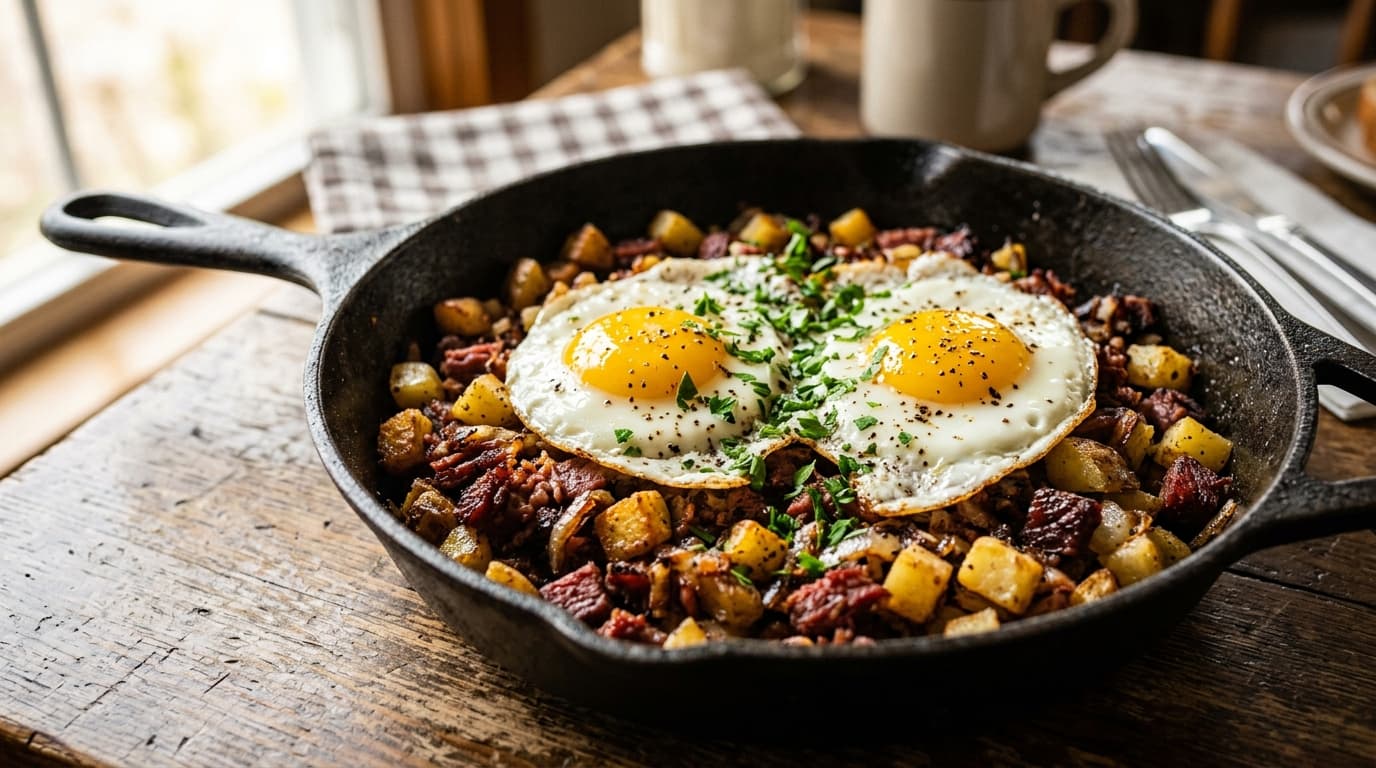
Corned Beef Hash with Eggs
Tender corned beef brisket and Yukon gold potatoes diced small, pan-crisped in seasoned cast iron with sweet caramelized onions, topped with sunny-side-up eggs featuring liquid golden yolks.
Macro Nutrition Profile (Per Serving)
Ingredients
Ingredient Substitutions
| Original Ingredient | Healthy Alternative |
|---|---|
| Poached eggs | Firm tofu slices (lightly pan-seared) or avocado slices (for a rich plant-based fat source) |
| Baby spinach | Swiss chard, baby kale, or arugula (wilt at the same temperature/time) |
| White vinegar | Lemon juice or apple cider vinegar (acid helps egg whites coagulate) |
Instructions
Dice the Chilled Brisket: Remove 3 cups (roughly 1 pound) of fully cooked, chilled corned beef brisket from the refrigerator. Using a sharp chef's knife, trim away any excessively thick exterior rubbery fat, leaving about 15% fat for flavor and browning. Slice the cold brisket against the grain into 1/4-inch slabs, then slice into 1/4-inch strips, and crosscut into neat 1/4-inch cubes. Keep chilled until ready to cook.
Par-Boil and Rough-Up the Potatoes: Peel 1 1/2 pounds of Yukon Gold potatoes and cut them into uniform 1/4-inch dice. Bring 2 quarts of water to a rolling boil in a medium pot over high heat. Stir in 1 teaspoon of kosher salt and 1/2 teaspoon of baking soda. Add the diced potatoes to the boiling water and cook for exactly 4 to 5 minutes, until you can pierce a cube with the tip of a paring knife with slight resistance (they must not be soft enough to mash). Drain the potatoes thoroughly in a colander. Let them steam dry for 2 minutes, then shake the colander vigorously 4 or 5 times. You will see a cloudy, starchy film coat the edges of each cube. Set aside.
Sauté the Onions and Aromatics: Place a heavy 12-inch seasoned cast-iron skillet over medium heat. Add 1 tablespoon of unsalted butter and 1 tablespoon of neutral oil or rendered bacon fat. Once the butter melts and foam subsides, add 1 1/2 cups of finely diced yellow onion. Cook for 5 to 6 minutes, stirring occasionally with a wooden spoon, until the onions are soft, translucent, and lightly golden around the edges. Add 2 cloves of finely minced garlic and cook for 60 seconds until fragrant. Transfer the cooked onion-garlic mixture to a large mixing bowl.
Combine the Hash Components: To the mixing bowl with the softened onions, add the par-boiled potatoes, diced cold corned beef, 1 tablespoon Worcestershire sauce, 1 teaspoon Dijon mustard, 1 teaspoon freshly cracked black pepper, 1/4 teaspoon ground allspice, 1/4 teaspoon smoked paprika, and 1/4 teaspoon kosher salt (taste a piece of cold beef first; if your brisket is heavily salted, omit added salt). Use a large rubber spatula to fold all ingredients together gently until the aromatics and seasoning are evenly dispersed.
The High-Heat Smash and Sear: Turn the heat under the cast-iron skillet to medium-high. Add the remaining 2 tablespoons of butter and 1 tablespoon of oil or bacon fat. Swirl the pan to ensure the entire bottom and lower walls are slick with hot fat. Dump the entire bowl of hash into the sizzling skillet. It should sizzle immediately upon contact. Using a wide, stiff metal spatula or the flat bottom of a heavy small saucepan, press the hash down firmly and evenly across the skillet floor, compacting it into a solid, flat cake. Reduce heat to medium. Cook undisturbed for 7 to 9 minutes. Do not stir, shake, or disturb the skillet. Listen to the sizzle: it should be steady and active. If you smell the slightest hint of scorching, turn the heat down slightly to medium-low. After 7 minutes, use your metal spatula to gently lift an edge. You should see a deep mahogany, crackling crust.
Flip and Crisp the Reverse Side: Using your metal spatula, cut the circular hash into four equal wedges. Slip the spatula completely under one quadrant and flip it over. Repeat with the remaining three quadrants. Some loose pieces will scatter—simply tuck them back in. Press the flipped hash down firmly again with your spatula. Cook undisturbed for another 5 to 7 minutes until the reverse side is equally golden, browned, and crisp throughout.
Fry the Eggs: While the hash finishes its second crust, you have two options for the eggs: Option A (Diner Skillet Method - Recommended): Use the back of a large spoon to press 4 deep wells or indentations into the top surface of the hash in the skillet. Crack one fresh egg into each well. Cover the skillet with a tight-fitting lid or a sheet of aluminum foil, reduce heat to low, and cook for 3 to 4 minutes until the egg whites are just opaque and set, but the yolks remain liquid and runny. Option B (Separate Basted Pan Method): In a separate nonstick skillet over medium-low heat, melt 1 tablespoon of butter. Fry 4 to 6 eggs sunny-side-up or over-easy until the whites are tender and the yolks are warm and fluid. Slide the fried eggs directly on top of the crisp hash.
Garnish and Serve: Scatter 2 tablespoons of finely chopped flat-leaf parsley across the top of the skillet. Season the egg yolks with a pinch of flaky sea salt and coarse cracked black pepper. Bring the entire cast-iron skillet straight to the table. Serve immediately with warm buttered toast, pickled hot peppers, and a bottle of vinegar-based hot sauce or whole-grain mustard.
The Red Flannel Hash (New England Heritage): In Vermont and coastal New England, traditional post-boiled-dinner hash includes boiled red beets. Fold in 1 cup of peeled, cooked, diced red beets along with the potatoes and beef. The beets impart an earthy sweetness, deep burgundy color, and moist interior that caramelizes beautifully against the salty meat.
Sweet Potato and Poblano Hash: Replace half of the Yukon gold potatoes with diced peeled sweet potatoes (jewel or garnet). Sauté 1 finely diced poblano pepper with the onions. The mild vegetal smokiness of the poblano cuts through the sweetness of the roasted sweet potatoes and cured brisket.
Brussels Sprouts and Grainy Mustard Hash: Shred 1 cup of fresh Brussels sprouts finely on a mandoline. Sauté them alongside the onions until charred around the edges before folding with the hash. Stir in an extra tablespoon of coarse stone-ground Dijon mustard.
Tried this recipe?
Let us know how it turned out! Click a star below to leave a review and rate the recipe.
Storage & Freezing Tips
- Refrigerator: Store in an airtight container for up to 2 days. Keep the components separate if possible to preserve texture.
- Reheating: Reheat gently in a skillet on medium-low heat with a splash of olive oil or butter.
- Freezing: Freezing is not recommended for this dish because ingredients like eggs become soggy, rubbery, or mushy when defrosted.
Frequently Asked Questions
Can this recipe be prepared ahead of time?▼
Yes, this meal is excellent for weekly meal prep. Store components separately and assemble before serving.
Is this recipe gluten-free?▼
All ingredients used are naturally gluten-free. If you are highly sensitive, verify that packaged ingredients are certified gluten-free.
Tried this recipe?
Tag @stewartlucas on Instagram and hashtag it #nutriguide!
You Might Also Like


Stewart Lucas
Nutritionist & Recipe DeveloperStewart Lucas is a nutritionist and recipe developer representing the NutriGuide team. All recipes, nutritional values, and diet protocols published on this site are designed and audited by certified dietitians and clinical nutrition professionals to guarantee absolute accuracy.
Community Reviews
Please log in to leave a review.