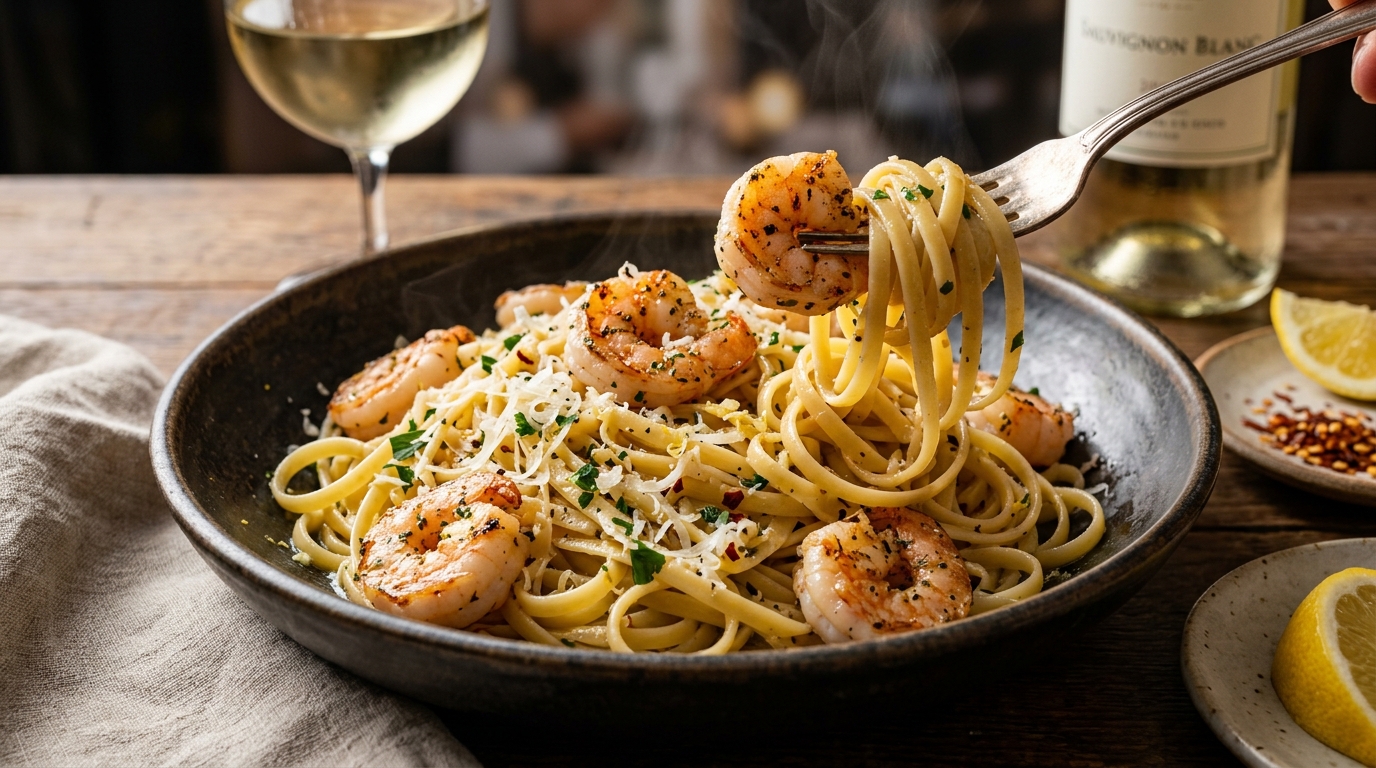
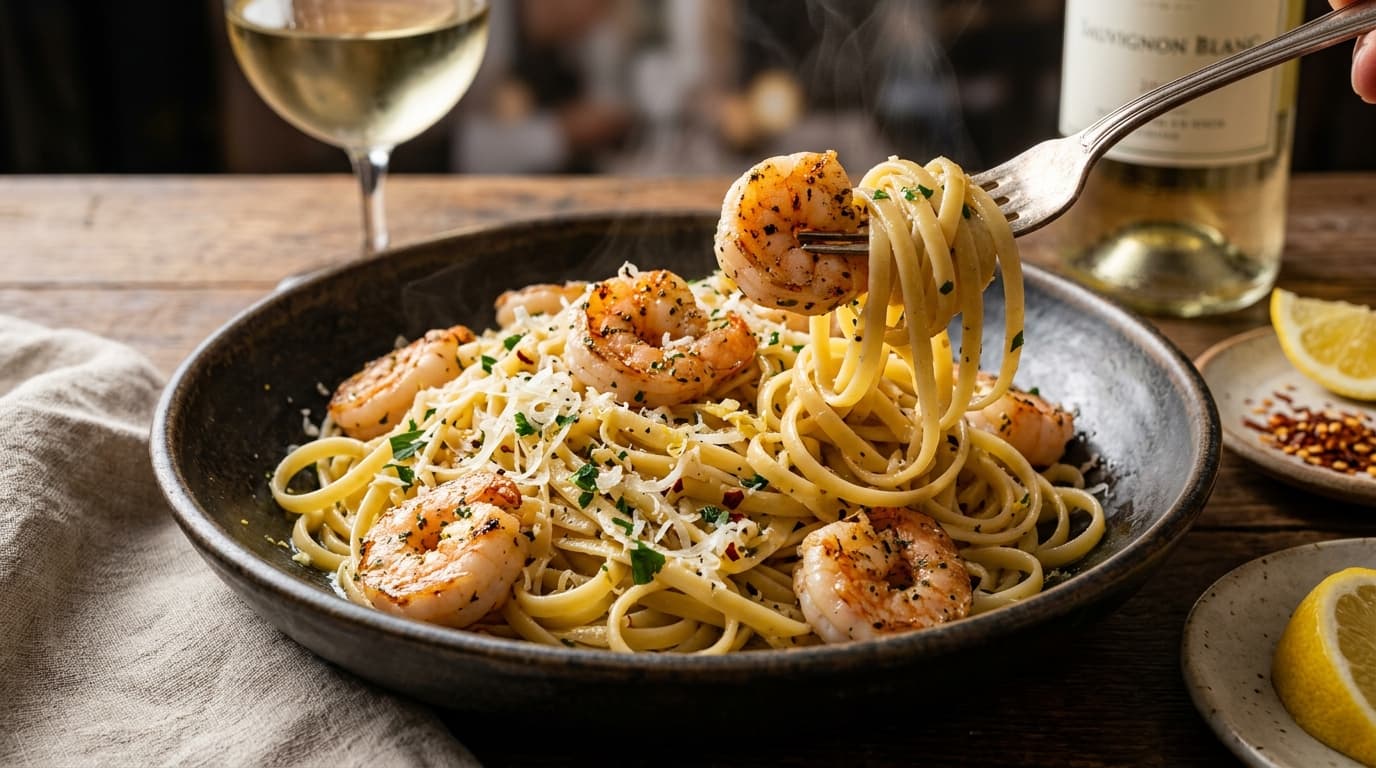
Garlic Butter Shrimp Pasta (20-Minute Creamy Linguine Masterclass)
Master bistro-grade Garlic Butter Shrimp Pasta in 20 minutes. Learn starch-emulsified pasta water binding, two-stage shrimp searing for maximum snap, dry white wine reduction, and incorporating 24-month Parmigiano-Reggiano off-heat to banish clumping forever.
Key Takeaways
- ✓Boil pasta in a shallow volume of salted water to concentrate amylose starches, creating an ultra-potent liquid emulsifier.
- ✓Execute two-stage cooking: sear shrimp to 80% doneness in foaming butter, remove immediately, build the sauce, and fold shrimp back in at the final 30 seconds.
- ✓Deglaze the pan with dry Italian white wine to extract the savory caramelized shrimp fond into the liquid butter base.
- ✓Incorporate grated Parmigiano-Reggiano strictly off the flame below 160�F (71�C) to prevent casein protein denaturation and unsightly gummy curdling.
- ✓Finish cooking the linguine directly in the skillet with the emulsified sauce and pasta water for the final 2 minutes (*mantecatura*) so the pasta absorbs flavor into its core.
The Story
The Story: Culinary Heritage & Masterclass Philosophy
Garlic butter shrimp pasta represents the glamorous intersection of Mediterranean coastal simplicity and classical Italian pasta engineering. In the trattorias lining the Amalfi coast, Venetian lagoons, and the Ligurian riviera, seafood pasta is regarded as sacred. The cardinal rule of authentic Italian pasta cookery is la mantecatura�the energetic, thermal marriage of al dente pasta, cooking fat, and starchy water in the pan until an indivisible, velvety emulsion coats every individual strand.
However, in mainstream Western kitchens, this beloved dish is often subjected to well-intentioned culinary malpractice. Home cooks frequently drown boiled noodles in excessive heavy cream, masking the delicate natural sweetness of the shrimp beneath a blanket of dairy grease. Alternatively, shrimp are dumped into boiling pasta water or left simmering in hot liquid for ten minutes, turning the meat into rubbery, fibrous pellets while shedding their sweet marine juices.
This masterclass restores the integrity of this classic bistro staple. By adhering to the thermodynamic laws of two-stage protein searing, harnessing the surface friction of bronze-die extruded semolina pasta, and mastering the colloid chemistry of starchy pasta water emulsification, you will create a luxurious, glossy garlic butter shrimp pasta that rivals the finest dining rooms of Rome and New York�all within twenty minutes.
The Science of Flavor Chemistry & Thermal Dynamics
The difference between an average, oily shrimp pasta and an extraordinary restaurant-quality creation comes down to molecular physics and emulsion chemistry.
1. The Physics of Mantecatura & Starch Chemistry
When durum wheat semolina is kneaded into dough and extruded through traditional rough bronze dies (as opposed to slick industrial Teflon dies), its surface is covered in microscopic crevices, ridges, and pits. When boiled in salted water, the surface starches�specifically amylose and amylopectin�begin to gelatinize and shed into the surrounding water.By cooking the pasta in a relatively modest volume of water (around 3 to 4 quarts instead of an excessive 6 to 8 quarts), we produce a cloudy, starch-dense liquid. When this hot starchy water is vigorously tossed into the pan with hot butterfat and olive oil, the amylose polymers act as natural microscopic surfactants. They lower the surface tension between the hydrophobic oil droplets and the hydrophilic water molecules, suspending the fat in tiny, stable droplets. This creates a lustrous, clinging sauce without requiring quarts of heavy cream.
2. The Two-Stage Protein Strategy
Shrimp cook at astonishing speed. At 140�F (60�C), crustacean myosin contracts; at 150�F (65�C), actin denatures and intracellular water is aggressively expelled.If raw shrimp are simmered alongside the pasta sauce as it reduces, the shrimp will spend 6 to 8 minutes in boiling liquid�at least 4 minutes too long. By employing a two-stage cooking method, we sear the shrimp in a hot skillet for only 90 seconds on side one and 45 seconds on side two, bringing them to approximately 80% doneness (core temperature ~125�F). We transfer them to a plate to rest while we reduce the wine, bloom the garlic, and emulsify the pasta. The shrimp are reintroduced during the final 30 seconds of mantecatura, allowing residual pan warmth to bring them to a juicy, crisp 135�F without overcooking.
3. Acid-Lipid Equilibrium: Slicing Through Satiety
Butterfat contains long-chain triglycerides that coat the tongue, delivering luxurious richness but quickly dulling taste bud sensitivity. To maintain culinary dynamism and keep the diner eager for the next bite, the sauce requires sharp, volatile organic acids.Dry Italian white wine introduces tartaric acid and malic acid, while fresh lemon juice delivers citric acid. These acids disrupt the heavy lipid coating on the palate, stimulating salivation and accentuating the natural sweetness of the shrimp's glycine amino acids. Adding the lemon zest introduces oil glands filled with limonene, an aromatic terpene that provides bright floral top notes without adding watery acidity.
4. Casein Denaturation & Cheese Clumping
Aged Parmigiano-Reggiano is a low-moisture, hard cheese composed primarily of fat and a dense protein network called casein. Casein proteins are heat-sensitive. If you dump grated Parmesan into a skillet bubbling over high heat (above 160�F / 71�C), the casein molecules violently aggregate and contract, squeezing out fat and water and forming rubbery, stringy clumps that stick to your tongs and skillet.To guarantee a smooth, velvety melt, two conditions must be met:
- The cheese must be microplaned into fine, airy ribbons at room temperature, maximizing surface area for rapid heat transfer.
- The skillet must be removed completely from active flame before the cheese is folded into the pasta. The residual heat of the 150�F pasta and starchy sauce gently melts the cheese fats while keeping the casein dispersed in suspension.
Essential Equipment & Thermal Calibration
Precision execution of garlic butter shrimp pasta relies on the right kitchen tools:
- Wide Stainless Steel Skillet or Saut� Pan with High Sloped Walls (12-inch): A wide saut� pan provides the surface area necessary to toss pasta vigorously (salto) with the sauce and starchy water without splashing over the sides.
- Heavy-Bottom Stockpot or Dutch Oven: For boiling the pasta with sufficient thermal stability so the water returns to a roaring boil immediately after the pasta is dropped.
- Stainless Steel Spider Strainer or Tongs: Tongs allow you to transfer the al dente pasta directly from the boiling water into the simmering sauce, carrying along valuable starchy surface water without losing heat.
- Fine Microplane Rasp: Essential for shaving garlic into thin slivers or mincing, zesting the lemon without pith, and grating the Parmigiano-Reggiano into feather-light curls.
Anatomy of the Ingredients & Artisanal Sourcing
The superiority of this dish rests upon the quality of its components:
- Bronze-Die Extruded Italian Linguine: Seek out traditional Italian pasta brands that state "Trafilata al Bronzo" on the box (such as De Cecco, Rummo, or Rustichella d'Abruzzo). Unlike smooth, mass-market extruded pasta, bronze-cut pasta has a chalky, pale, coarse exterior that physically grabs the garlic butter emulsion. Linguine's flat, oval cross-section provides the ideal surface-area-to-mass ratio for seafood sauces.
- Wild-Caught Jumbo Shrimp (16/20 or 21/25 Count): Wild shrimp possess firmer muscle structure and higher concentrations of glycine and alanine (sweet amino acids) than farmed shrimp. Ensure they are thoroughly peeled and deveined. For pasta, removing the tails is generally preferred so diners can eat effortlessly with a fork.
- Authentic Parmigiano-Reggiano DOP (Aged 24 Months): Do not use pre-shredded cheese in plastic tubs, which is coated in cellulose anti-caking agents that ruin sauce emulsification. Authentic 24-month DOP Parmigiano provides crystalized crunch (tyrosine amino acid clusters), rich glutamates (natural umami), and a nutty, savory profile that amplifies the seafood.
- Dry White Wine (Italian Pinot Grigio or Sauvignon Blanc): Choose a crisp, bone-dry wine with high acidity and zero residual sugar. The wine deglazes the pan fond, dissolves sticky caramelized shrimp proteins, and provides tartaric acid balance. Avoid oak-aged wines whose vanilla compounds clash harshly with garlic and shellfish.
- Heavy Whipping Cream (36% Butterfat): We use a restrained 1/3 cup of cream. This is not an Alfredo sauce; the cream simply provides extra lecithin and milk fat to stabilize the butter-wine-starch emulsion, lending a velvety sheen without weighing the dish down.
Step-by-Step Culinary Masterclass
Step 1: Alkaline Pre-Treatment & Pasta Water Setup
Toss the peeled, deveined shrimp in a bowl with 1/4 teaspoon of baking soda and 1/2 teaspoon of salt. Rest for 15 minutes, then blot aggressively with paper towels until bone-dry. Bring a large pot filled with 3.5 quarts of water to a rolling boil. Add 2 tablespoons of Kosher salt (the water should taste seasoned like clean sea water). Drop the 1 lb of linguine into the boiling water, stirring continuously for the first 60 seconds to prevent strands from adhering.
- Chef's Technique Tip: Cook the pasta for 2 minutes LESS than the package's recommended 'al dente' time. It will finish cooking directly in the sauce, absorbing the garlic butter emulsion into its cellular core.
- Sensory Checkpoint: The pasta should be firm with a chalky white center pinhead when bitten, and the boiling water will turn cloudy with released starches.
Step 2: Two-Stage High-Heat Shrimp Searing
While pasta boils, place a 12-inch wide stainless steel skillet over medium-high heat. Add 2 tablespoons of olive oil and 2 tablespoons of the butter. Once the butter foams and subsides, add the shrimp in a single layer. Sear undisturbed for 90 seconds until the underside develops a golden-amber crust. Flip and cook for just 45 seconds on the second side until loosely 'C' shaped and 80% opaque. Immediately transfer the shrimp and any pan drippings onto a clean plate and set aside.
- Chef's Technique Tip: Do not cook the shrimp to 100% completion now. They will finish gently in the residual heat of the pasta at the very end.
- Sensory Checkpoint: Shrimp have a deep pink hue, golden-seared edges, and a translucent, tender core.
Step 3: Building the Aromatics & Wine Deglaze
Lower the skillet heat to medium. Add 2 more tablespoons of butter to the residual pan oils. Add the 7 cloves of minced garlic and 1/2 teaspoon of crushed red pepper flakes. Saut� for 45 to 60 seconds, stirring constantly with a wooden spoon, until the garlic is fragrant, translucent, and sweet. Pour in 1/2 cup of dry white wine. Scrape up the rich browned fond from the bottom of the skillet. Simmer over medium-high heat for 2 minutes until the wine has reduced by roughly half.
- Chef's Technique Tip: Watch the garlic carefully; if the pan is too hot, slide it off the burner for 10 seconds. Garlic should never brown in this delicate sauce.
- Sensory Checkpoint: The wine will reduce into a fragrant, syrupy, golden-flecked reduction with sweet, floral garlic aromas.
Step 4: Emulsifying Cream & Starchy Pasta Water
Stir in 1/3 cup of heavy cream, 2 tablespoons of fresh lemon juice, and 1/2 teaspoon of fresh lemon zest. Bring to a gentle simmer for 1 minute. Using tongs, transfer the undercooked linguine directly from the boiling pot into the simmering skillet. Ladle 1/2 cup of hot, starchy pasta cooking water into the skillet. Increase heat to medium-high and toss the pasta vigorously with the tongs in a circular folding motion for 90 seconds.
- Chef's Technique Tip: The continuous agitation of the pasta strands in the bubbling liquid forces the starch molecules to bind the butter, cream, and wine into a rich, cohesive emulsion.
- Sensory Checkpoint: The liquid transforms into a glossy, creamy sauce that coats every strand of linguine without settling into a pool at the bottom.
Step 5: Off-Heat Cheese Fold & Shrimp Reintroduction
Remove the skillet completely from the heat source. Add the remaining 2 tablespoons of chilled butter and the 3/4 cup of finely grated Parmigiano-Reggiano. Toss vigorously until the cheese melts seamlessly into the velvety sauce without clumping. Reintroduce the seared shrimp along with any accumulated flavorful juices from the plate. Add 1/2 cup of finely chopped Italian parsley. Toss for 30 seconds until the shrimp are warmed through and glistening.
- Chef's Technique Tip: If the pasta appears tight or dry, add another 2 to 3 tablespoons of hot pasta water to restore a luxurious, fluid sauce consistency.
- Sensory Checkpoint: The sauce is creamy, glossy, and perfectly unified, clinging to the linguine with zero grease separation or stringy cheese clumps.
Step 6: Garnish & Table Presentation
Twirl generous nests of linguine into warm, shallow pasta bowls using tongs and a large ladle. Arrange 5 to 6 plump seared shrimp over the crown of each pasta nest. Spoon remaining garlic butter sauce from the skillet over top. Finish with an extra dusting of freshly grated Parmigiano-Reggiano, fresh parsley, a crack of black pepper, and serve immediately with fresh lemon wedges.
- Chef's Technique Tip: Pre-warming your pasta bowls by rinsing them in hot water keeps the delicate butter emulsion warm and fluid at the dining table.
- Sensory Checkpoint: Steaming ribbons of golden pasta, vibrant green parsley specks, and succulent pink shrimp ready to eat.
Pro-Chef Troubleshooting & Critical Checkpoints
Problem: The Parmigiano-Reggiano Clumped into a Sticky, Chewy Ball
- The Root Cause: Cheese was added while the pan was boiling over direct flame, causing casein proteins to contract and separate from their fats.
- The Masterclass Solution: Always pull the skillet completely off the heat before folding in cheese. Ensure your cheese is microplaned finely rather than shredded thickly.
Problem: The Sauce Separated into an Oily, Greasy Puddle
- The Root Cause: The sauce lacked sufficient emulsifying starch, or the liquid evaporated too far, breaking the fat-in-water emulsion.
- The Masterclass Solution: Vigorously whisk in 2 to 3 tablespoons of hot, starchy pasta water off the heat to immediately reconstitute the emulsion.
Problem: The Shrimp are Dry and Overcooked
- The Root Cause: Shrimp were kept in the pan while the sauce and pasta simmered, exposing them to prolonged boiling heat.
- The Masterclass Solution: Follow the two-stage protocol: sear shrimp first for under 2.5 minutes total, remove them to a plate, and fold them back in only in the final 30 seconds.
Problem: The Pasta is Mushy and Limp
- The Root Cause: Linguine was boiled fully tender in the pot before hitting the skillet, causing double-cooking during the sauce toss.
- The Masterclass Solution: Drain or transfer pasta when it is still chalky and firm�at least 2 full minutes before the package's al dente timer.
Problem: The Flavor is Bland or Lacks Depth
- The Root Cause: The pasta water was under-salted, or insufficient lemon juice and wine were used to balance the heavy dairy fats.
- The Masterclass Solution: Ensure pasta water is seasoned with 2 tbsp salt per gallon, and brighten the finished dish with an extra squeeze of fresh lemon juice and sea salt.
Macro Analysis & Nutritional Optimization
This dish unites high-density marine protein with complex carbohydrates and bioavailable fats:
- Lean Marine Protein Source: Jumbo wild shrimp provide approximately 36 grams of complete protein per serving, containing all nine essential amino acids required for cellular repair, immune response, and lean muscle synthesis.
- Sustained Carbohydrate Energy: Bronze-die durum wheat semolina possesses a lower glycemic response than processed white flour, delivering sustained glycogen replenishment for athletes and active individuals.
- Bioavailable Calcium & Vitamin K2: Genuine aged Parmigiano-Reggiano provides exceptionally bioavailable calcium bound to milk phosphoproteins, along with Vitamin K2 (menaquinone-7) which directs calcium into bone tissue rather than arterial walls.
- Cardiovascular-Friendly Polyphenols: Cold-pressed extra virgin olive oil and fresh garlic supply potent polyphenols and organosulfur compounds that protect blood lipids from oxidation.
Artisanal Serving & Pairing Architecture
Garlic butter shrimp pasta is a rich, aromatic entr�e that pairs exquisitely with vibrant, crisp accompaniments:
- Wine Recommendations:
- Side Salads:
- Bread Accompaniment: Warm roasted garlic focaccia with rosemary and sea salt.
Scientific Storage, Meal Prep & Reheating Protocol
Seafood pasta requires attentive handling to maintain sauce integrity:
- Refrigeration: Cool leftover pasta within 45 minutes of cooking. Store in an airtight glass container in the coldest zone of the refrigerator (below 38�F / 3�C) for up to 2 days.
- Why the Microwave Fails: Microwaving separates the butter and cream into a puddle of oil while turning the shrimp into rubbery pellets.
- The Perfect Stovetop Reheat: Heat a wide skillet over medium-low. Add 2 to 3 tablespoons of chicken broth, whole milk, or water. Add the chilled pasta and shrimp. Cover with a lid and steam gently for 3 to 4 minutes, swirling occasionally. As the liquid heats, use tongs to gently toss the noodles until the sauce reconstitutes into a glossy cream. Remove the moment the shrimp are warm.
- Freezer Advisory: Freezing is not recommended for this dish; dairy emulsions break during freezing, and thawed cooked shrimp lose their crisp texture.
Frequently Asked Questions (Masterclass Edition)
Q: Can I make this without white wine?
A: Yes! Substitute the white wine with 1/2 cup of low-sodium chicken broth or seafood stock, combined with 1 tablespoon of fresh lemon juice and 1/2 teaspoon of white wine vinegar to mirror the wine's natural acidity.Q: Can I substitute another pasta shape for linguine?
A: Absolutely. Fettuccine, tagliatelle, spaghetti, or bucatini work wonderfully. For short pasta, choose ridged bronze-cut shapes like rigatoni or penne rigate which hold onto the garlic butter emulsion.Q: Can I make this dairy-free or gluten-free?
A: Yes. For gluten-free, use a high-quality bronze-die brown rice or corn-blend pasta (like Jovial). For dairy-free, substitute European butter with high-quality vegan plant butter (like Miyoko's), use full-fat canned coconut cream or cashew cream, and replace parmesan with nutritional yeast or dairy-free parmesan.Q: Why should I save the pasta cooking water?
A: Pasta water contains dissolved amylose starch shed from the noodles during boiling. This starch acts as an emulsifying agent that binds the butterfat and wine together into a silky, clingy sauce. Without it, the sauce will separate into greasy oil.Q: Should I peel the tails off the shrimp for pasta?
A: For pasta dishes, it is generally recommended to remove the tails before searing so that diners can twirl pasta and eat without having to handle shrimp tails with their fingers.Garlic Butter Shrimp Pasta (20-Minute Creamy Linguine Masterclass)
Master bistro-grade Garlic Butter Shrimp Pasta in 20 minutes. Learn starch-emulsified pasta water binding, two-stage shrimp searing for maximum snap, dry white wine reduction, and incorporating 24-month Parmigiano-Reggiano off-heat to banish clumping forever.
Macro Nutrition Profile (Per Serving)
Ingredients
Ingredient Substitutions
| Original Ingredient | Healthy Alternative |
|---|---|
| Animal protein | Firm tofu, tempeh, or organic chickpeas |
| Cooking fat | Extra virgin olive oil or grass-fed butter |
Instructions
Alkaline Pre-Treatment & Pasta Water Setup: Toss the peeled, deveined shrimp in a bowl with 1/4 teaspoon of baking soda and 1/2 teaspoon of salt. Rest for 15 minutes, then blot aggressively with paper towels until bone-dry. Bring a large pot filled with 3.5 quarts of water to a rolling boil. Add 2 tablespoons of Kosher salt (the water should taste seasoned like clean sea water). Drop the 1 lb of linguine into the boiling water, stirring continuously for the first 60 seconds to prevent strands from adhering. Chef's Technique Tip: Cook the pasta for 2 minutes LESS than the package's recommended 'al dente' time. It will finish cooking directly in the sauce, absorbing the garlic butter emulsion into its cellular core. Sensory Checkpoint: The pasta should be firm with a chalky white center pinhead when bitten, and the boiling water will turn cloudy with released starches.
Two-Stage High-Heat Shrimp Searing: While pasta boils, place a 12-inch wide stainless steel skillet over medium-high heat. Add 2 tablespoons of olive oil and 2 tablespoons of the butter. Once the butter foams and subsides, add the shrimp in a single layer. Sear undisturbed for 90 seconds until the underside develops a golden-amber crust. Flip and cook for just 45 seconds on the second side until loosely 'C' shaped and 80% opaque. Immediately transfer the shrimp and any pan drippings onto a clean plate and set aside. Chef's Technique Tip: Do not cook the shrimp to 100% completion now. They will finish gently in the residual heat of the pasta at the very end. Sensory Checkpoint: Shrimp have a deep pink hue, golden-seared edges, and a translucent, tender core.
Building the Aromatics & Wine Deglaze: Lower the skillet heat to medium. Add 2 more tablespoons of butter to the residual pan oils. Add the 7 cloves of minced garlic and 1/2 teaspoon of crushed red pepper flakes. Saut� for 45 to 60 seconds, stirring constantly with a wooden spoon, until the garlic is fragrant, translucent, and sweet. Pour in 1/2 cup of dry white wine. Scrape up the rich browned fond from the bottom of the skillet. Simmer over medium-high heat for 2 minutes until the wine has reduced by roughly half. Chef's Technique Tip: Watch the garlic carefully; if the pan is too hot, slide it off the burner for 10 seconds. Garlic should never brown in this delicate sauce. Sensory Checkpoint: The wine will reduce into a fragrant, syrupy, golden-flecked reduction with sweet, floral garlic aromas.
Emulsifying Cream & Starchy Pasta Water: Stir in 1/3 cup of heavy cream, 2 tablespoons of fresh lemon juice, and 1/2 teaspoon of fresh lemon zest. Bring to a gentle simmer for 1 minute. Using tongs, transfer the undercooked linguine directly from the boiling pot into the simmering skillet. Ladle 1/2 cup of hot, starchy pasta cooking water into the skillet. Increase heat to medium-high and toss the pasta vigorously with the tongs in a circular folding motion for 90 seconds. Chef's Technique Tip: The continuous agitation of the pasta strands in the bubbling liquid forces the starch molecules to bind the butter, cream, and wine into a rich, cohesive emulsion. Sensory Checkpoint: The liquid transforms into a glossy, creamy sauce that coats every strand of linguine without settling into a pool at the bottom.
Off-Heat Cheese Fold & Shrimp Reintroduction: Remove the skillet completely from the heat source. Add the remaining 2 tablespoons of chilled butter and the 3/4 cup of finely grated Parmigiano-Reggiano. Toss vigorously until the cheese melts seamlessly into the velvety sauce without clumping. Reintroduce the seared shrimp along with any accumulated flavorful juices from the plate. Add 1/2 cup of finely chopped Italian parsley. Toss for 30 seconds until the shrimp are warmed through and glistening. Chef's Technique Tip: If the pasta appears tight or dry, add another 2 to 3 tablespoons of hot pasta water to restore a luxurious, fluid sauce consistency. Sensory Checkpoint: The sauce is creamy, glossy, and perfectly unified, clinging to the linguine with zero grease separation or stringy cheese clumps.
Garnish & Table Presentation: Twirl generous nests of linguine into warm, shallow pasta bowls using tongs and a large ladle. Arrange 5 to 6 plump seared shrimp over the crown of each pasta nest. Spoon remaining garlic butter sauce from the skillet over top. Finish with an extra dusting of freshly grated Parmigiano-Reggiano, fresh parsley, a crack of black pepper, and serve immediately with fresh lemon wedges. Chef's Technique Tip: Pre-warming your pasta bowls by rinsing them in hot water keeps the delicate butter emulsion warm and fluid at the dining table. Sensory Checkpoint: Steaming ribbons of golden pasta, vibrant green parsley specks, and succulent pink shrimp ready to eat.
Tried this recipe?
Let us know how it turned out! Click a star below to leave a review and rate the recipe.
Storage & Freezing Tips
- Refrigerator: Store in an airtight container for up to 2 days. Keep the components separate if possible to preserve texture.
- Reheating: Reheat gently in a skillet on medium-low heat with a splash of olive oil or butter.
- Freezing: Freezing is not recommended for this dish because ingredients like eggs become soggy, rubbery, or mushy when defrosted.
Frequently Asked Questions
Can this recipe be prepared ahead of time?▼
Yes, this meal is excellent for weekly meal prep. Store components separately and assemble before serving.
Is this recipe gluten-free?▼
All ingredients used are naturally gluten-free. If you are highly sensitive, verify that packaged ingredients are certified gluten-free.
Tried this recipe?
Tag @stewartlucas on Instagram and hashtag it #nutriguide!
You Might Also Like

Stewart Lucas
Nutritionist & Recipe DeveloperStewart Lucas is a nutritionist and recipe developer representing the NutriGuide team. All recipes, nutritional values, and diet protocols published on this site are designed and audited by certified dietitians and clinical nutrition professionals to guarantee absolute accuracy.
Community Reviews
Please log in to leave a review.