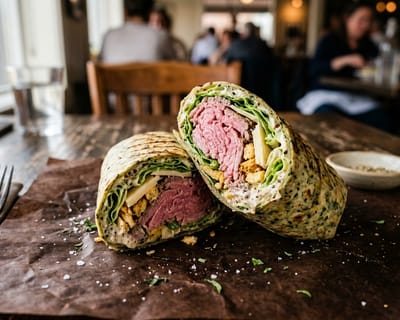
Roast Beef Caesar Wrap
Thinly shaved medium-rare roast beef, crisp romaine lettuce, shaved Parmigiano-Reggiano, coarse garlic herb croutons, and rich scratch Caesar dressing rolled tightly in a toasted spinach-herb tortilla.
Key Takeaways
- ✓Ready in just 10 mins using straightforward, kitchen-tested technique.
- ✓Delivers 42g of muscle-fueling protein per serving for lasting satiety.
- ✓Portion-balanced at 580 calories per serving with wholesome, unrefined ingredients.
- ✓Masterclass temperature checkpoints ensure maximum tenderness and flavor development.
The Story
The Roast Beef Caesar Wrap represents one of the most successful adaptations of classic restaurant dining into portable delicatessen fare. By uniting the rich, savory depth of thinly shaved medium-rare beef with the crisp, water-rich crunch of fresh romaine lettuce, pungent garlic, aged Parmigiano-Reggiano, and umami-dense scratch Caesar dressing inside a toasted spinach-herb tortilla, it delivers a complete steakhouse salad experience in a clean, handheld format.
Despite its straightforward nature, wraps frequently suffer from common mechanical and culinary failures: soggy, tearing tortillas that rupture at the seams, stringy meat that pulls out in a single tough slab, waterlogged lettuce that turns the roll soupy, or an unbalanced dressing that lacks the bracing lemon and garlic punch needed to cut through red meat lipids.
Mastering this wrap requires understanding meat slicing physics, controlling vegetable moisture, balancing umami and lipid chemistry in cold emulsions, and executing a structural pan-sear.
Culinary Heritage: From Tijuana Cardini to California Delicatessens
The Caesar salad was invented on the Fourth of July weekend in 1924 by Italian-American restaurateur Caesar Cardini at his restaurant in Tijuana, Mexico. Facing a depleted pantry amid an influx of American tourists avoiding Prohibition, Cardini gathered romaine lettuce hearts, coddled eggs, garlic-infused olive oil, Worcestershire sauce, lemon juice, grated Parmesan, and toasted bread croutons, tossing them tableside with dramatic flair. Notably, Cardini's original preparation relied on Worcestershire sauce rather than canned anchovies for its briny, fermented undertone; the addition of salted anchovy fillets became standard practice later as chefs sought a more assertive savory profile.
During the mid-1990s, the culinary landscape in Southern California and New York saw the rise of the gourmet wrap. Chefs recognized that the large flour tortillas developed for Mission-style burritos could serve as versatile containers for composed composed salads. While grilled chicken Caesar wraps quickly became ubiquitous across office lunch counters, pairing Caesar greens with thinly shaved roast beef created a far more compelling dynamic. The high mineral content, intramuscular moisture, and savory glutamates of roasted beef provide a grounding richness that balances the sharp acidity of lemon, the pungent bite of allicin in raw garlic, and the salty brine of cured anchovies.
The Food Science of Deli Roast Beef: Meat Slicing Physics
The tenderness of roast beef inside a wrap is determined almost entirely by blade mechanics and fiber orientation:
1. The Perpendicular Slicing Rule
Beef top round (inside round) and eye of round are composed of long, parallel muscle fibers (fascicles) bound by tough collagen sheaths.- The Slab Defect: If roast beef is sliced along the grain or cut into thick slabs (1/8 inch or thicker), these longitudinal fibers retain high tensile strength. When bitten into, human teeth struggle to shear through the parallel grain, causing the entire beef portion to pull out of the wrap in a single piece, collapsing the sandwich and leaving the diner holding an empty tube of lettuce.
- The Gossamer Ribbon Solution: When shaved wafer-thin against the grain on a commercial meat slicer (setting #0.5 or #1) or with a razor-sharp carving knife, the longitudinal muscle fibers are severed into microscopic cross-sections.
- These thin, gossamer ribbons collapse effortlessly under gentle bite pressure, providing tender chew while exposing expansive surface area that captures Caesar dressing and melted cheese.
2. Temperature and Moisture Retention
Medium-rare roast beef cooked to an internal temperature of 130°F to 135°F (54°C to 57°C) retains its bound intracellular water and myoglobin. When chilled down to 34°F to 38°F (1°C to 3°C), the intramuscular fats and residual gelatinized collagen solidify, making it easy to slice into gossamer ribbons without leaking juices across the cutting board.3. Choosing the Cut: Top Round vs. Sirloin vs. Tenderloin
- Top Round (Inside Round): The deli standard. Lean, highly beefy, and cost-effective. When slow-roasted to medium-rare and shaved thin, it offers exceptional beef flavor without greasy residue.
- Top Sirloin: Offers slightly more intramuscular marbling and a deeper mineral sweetness. Excellent if roasting at home for wraps.
- Beef Tenderloin (Filet Mignon): Exceptionally tender, but lacks the deep beefy assertiveness needed to stand up against pungent garlic and anchovies. Top round or sirloin is culinarily superior in a Caesar wrap.
The Umami Synergy: Anchovy, Parmesan, and Red Meat
The pairing of roast beef with Caesar dressing succeeds because of nucleotide and glutamate synergy:
- Free Glutamates in Aged Cheese: Parmigiano-Reggiano aged for 24 months contains high concentrations of free glutamic acid (roughly 1,600 mg per 100g).
- Inosinate Nucleotides in Anchovies and Beef: Anchovies and roasted red meat are packed with inosine monophosphate (IMP).
- The Flavor Multiplier: When free glutamates pair with inosinate nucleotides on the human tongue, they bind to the umami taste receptors (T1R1/T1R3) simultaneously, amplifying the perceived savory depth by up to eight times compared to either ingredient eaten in isolation.
- Citric Acid and Mustard Pungency: Fresh lemon juice and Dijon mustard supply citric acid and sinigrin glucosinolates. This acidic bite cuts through the heavy animal fats of the roast beef and mayonnaise, refreshing the palate between bites.
The Chemistry of Emulsified Caesar Dressing
A watery, broken Caesar dressing will run straight into the bottom folds of the wrap, dissolving the flour starches and turning the flatbread gummy within minutes. A properly emulsified dressing clings to the hydrophobic waxy surface of romaine leaves like a glossy velvet coat:
1. The Mayonnaise Shortcut vs. Raw Egg Yolk
Traditional Caesar dressing relies on whisking raw egg yolks with oil to form an oil-in-water emulsion. For everyday food safety, convenience, and structural stability, using high-quality commercial mayonnaise (which consists of pasteurized egg yolks emulsified with oil) provides an unbreakable emulsion base.2. Microplaning Garlic: Controlling Allicin
Raw garlic contains alliin and the enzyme alliinase in separate cellular compartments. When garlic is crushed or grated on a microplane, the cell walls rupture, allowing alliinase to convert alliin into allicin—the chemical responsible for sharp, biting garlic heat.- Mincing garlic with a knife produces coarse pieces that deliver harsh, burning bursts when chewed.
- Grating a single clove finely on a microplane distributes the allicin evenly throughout the acidic mayonnaise, where lemon juice moderates its pungent sharpness into a smooth, savory warmth.
3. Real Parmigiano-Reggiano vs. Cellulose-Coated Pre-Grated Cheese
Always use authentic Parmigiano-Reggiano grated directly from the wedge. Commercial pre-shredded cheese is coated with powdered cellulose (wood pulp) and potato starch to prevent clumping in the container. When stirred into dressing, cellulose absorbs moisture and creates a chalky, paste-like mouthfeel instead of melting seamlessly into the lipid suspension.Crouton Engineering: Crunch Longevity Under Hydrophobic Barriers
A Caesar salad is incomplete without the textural contrast of croutons, but whole commercial croutons are hard cubes that will puncture the delicate tortilla skin during rolling.
1. The Stale Bread Foundation
Use day-old artisanal sourdough or a crusty French baguette. The irregular air pockets of artisan bread absorb olive oil and seasoning while retaining structural rigidity under moisture stress.2. The Pebble Crush Technique
Instead of leaving croutons as 3/4-inch hard cubes, place them in a zip-top bag and crush them gently with the heel of your hand into irregular 1/4-inch to 1/2-inch jagged fragments.- These flat, crushed pebbles disperse evenly throughout the romaine ribbons.
- They provide audible, shatteringly crisp texture in every bite without presenting sharp corners that pierce the tortilla.
3. The Oil Shield
Baking the croutons in extra virgin olive oil coats the exterior starches in a hydrophobic lipid barrier. This lipid layer slows down moisture absorption from the dressed greens, keeping the croutons crisp for several hours inside the wrapped flatbread.Structural Flatbread Engineering: The Moisture Defense
A wrap must withstand the moisture of dressed greens and meat without disintegrating:
1. The Salad Spinner Mandate
Romaine lettuce is 95% water. When lettuce leaves are washed and not dried thoroughly, residual surface water dilutes the dressing. The diluted dressing washes away from the leaves and pools in the bottom fold of the tortilla, softening the wheat starches into a gummy paste within 10 minutes.- Always chop crisp romaine hearts into 1/2-inch ribbons.
- Spin vigorously in a salad spinner until not a single droplet of surface water remains.
2. The Meat Wall Defense
When assembling the wrap, place the shaved roast beef directly across the center of the warmed tortilla, forming an initial foundational layer. Place the tossed Caesar salad and croutons on top* of the beef layer, rather than directly on the flatbread.- The dense protein and fat of the roast beef act as a hydrophobic shield, preventing the salad dressing from directly touching the tortilla wall during rolling.
3. The 375°F Griddle Seam Lock
Toasting the rolled cylinder on a hot skillet seam-side down melts the overlapping starch folds together, permanently sealing the wrap shut while creating a rigid, toasted exterior shell that prevents structural collapse.Step-by-Step Instructions
Follow these steps for the ultimate roast beef Caesar wrap:
Step 1: Whisk the Scratch Caesar Dressing
In a medium glass or stainless-steel bowl, combine 1/2 cup of mayonnaise, 2 minced anchovy fillets (or 1 teaspoon anchovy paste), 1 finely grated garlic clove, 1 tablespoon of freshly squeezed lemon juice, 1 teaspoon of Dijon mustard, 1 teaspoon of Worcestershire sauce, and 1/4 teaspoon of freshly cracked black pepper.Whisk vigorously with a small wire whisk until completely smooth, creamy, and emulsified.
Stir in 1/4 cup of finely grated Parmigiano-Reggiano. Taste the dressing; it should be assertive, tangy, savory, and rich. Cover with plastic wrap and refrigerate for at least 15 minutes to allow the garlic and anchovy flavors to mellow and integrate into the lipid matrix.
Step 2: Prep and Toss the Caesar Greens
Wash 2 large heads of crisp romaine lettuce hearts under cold running water. Discard any limp outer leaves.Using a sharp chef's knife, trim the root end and slice the hearts crosswise into clean 1/2-inch wide ribbons.
Transfer the ribbons to a salad spinner and spin vigorously for 30 to 45 seconds until the leaves are completely dry. (Feel the leaves with your dry hands; there should be zero dampness).
Transfer 6 cups of the dry shredded romaine to a large mixing bowl. Add 3/4 cup of shaved Parmigiano-Reggiano and 1 cup of lightly crushed garlic herb crouton fragments.
Drizzle 1/3 to 1/2 cup of the chilled Caesar dressing over the greens. Using salad tongs, toss gently from the bottom up until every ribbon of lettuce is coated in a light, glossy sheen of dressing. Do not drown the greens; they should remain stiff, crisp, and lively.
Step 3: Season the Shaved Roast Beef
On a clean cutting board, gently separate 1 1/2 pounds of wafer-thin shaved medium-rare roast beef into loose, airy ribbons.Drizzle with 1 tablespoon of extra virgin olive oil, 1/2 teaspoon of Worcestershire sauce, and a generous dusting of freshly cracked coarse black pepper.
Toss lightly with your fingers to distribute the seasoning without compressing the delicate ribbons into a dense ball. Keeping the ribbons loose ensures they fold smoothly inside the flatbread.
Step 4: Warm the Tortillas
Heat a large dry cast-iron skillet, nonstick pan, or flat griddle over medium heat (roughly 350°F / 175°C).Place one 12-inch spinach-herb flour tortilla onto the dry pan. Warm for 12 to 15 seconds, then flip and warm the other side for 10 seconds.
The tortilla should feel steaming hot, soft, and completely pliable, but not crispy or browned. (Warming gelatinizes the wheat starches and softens shortening, preventing hairline fractures during rolling). Transfer the warm tortilla immediately to a clean work board.
Step 5: Assemble the Layered Fillings
- Across the center third of the warm tortilla, smear 1 teaspoon of Caesar dressing to lightly moisten the base.
- Layer approximately 6 ounces of the seasoned shaved roast beef across the center third, leaving a clear 2-inch bare border on both the left and right sides.
- Heap a generous 1 1/2-cup mound of the dressed Caesar romaine greens, shaved Parmesan, and crushed croutons directly over the roast beef layer.
- Scatter thinly sliced red onions (or pickled red onions) across the top of the greens.
- Finish with an extra pinch of freshly cracked black pepper and a few shavings of Parmesan cheese.
Step 6: Roll into a Tight Burrito-Style Cylinder
Fold the left and right bare sides of the tortilla inward over the ends of the filling by approximately 2 inches.While holding the sides firmly tucked inward with your thumbs and pinkies, use your index and middle fingers to pull the bottom edge of the tortilla up and over the filling mound.
Pull the flap backward slightly toward yourself to compact the meat, croutons, and greens into a firm, tight cylinder.
Continue rolling forward tightly with steady pressure until the top flap overlaps and the cylinder is completely enclosed. Place the wrap seam-side down on the board while you assemble the remaining three wraps.
Step 7: Toast the Seam on the Skillet
Set your cast-iron skillet over medium heat (roughly 375°F / 190°C). Lightly brush the exterior of each rolled wrap with melted unsalted butter (or spray lightly with olive oil cooking spray).Place the wrap seam-side down directly onto the hot skillet surface. Cook undisturbed for 2 to 3 minutes. The direct thermal contact melts the overlapping starch folds together, welding the seam permanently shut while developing a crisp, golden-brown crust.
Carefully flip the wrap with a wide metal spatula and toast the opposite side for 1 1/2 to 2 minutes until golden, crisp, and lightly toasted.
Step 8: Slice on the Bias and Serve
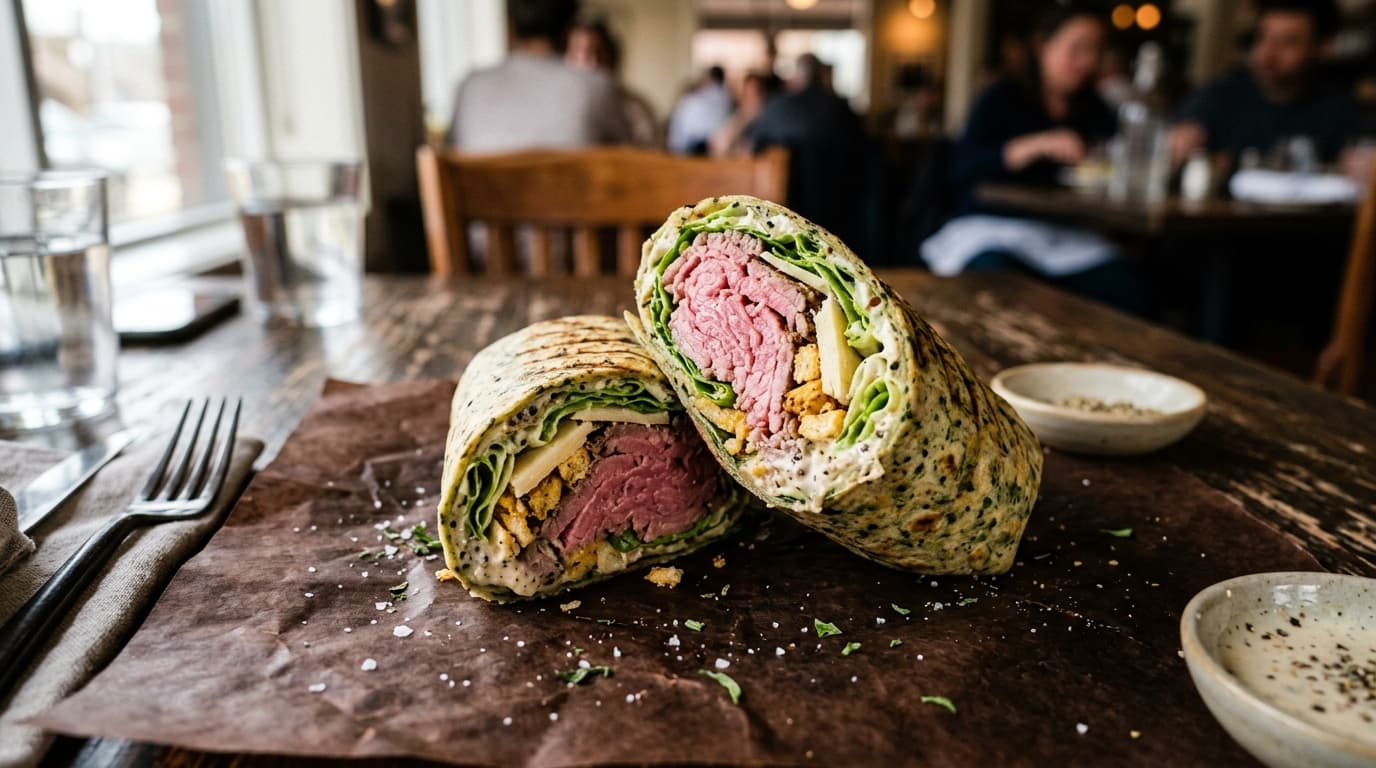
Transfer the toasted wraps to a cutting board. Allow them to rest undisturbed for 60 to 90 seconds. Resting allows the melted fats to stabilize so the fillings stay in place when sliced.Using a very sharp, thin-bladed chef's knife or santoku knife, slice the wrap diagonally across the middle at a 45-degree angle (on the bias). Slicing on the bias exposes the colorful cross-section of pink medium-rare beef ribbons, green romaine, white Parmesan curls, and golden croutons.
Arrange the two halves cut-side up on a serving plate. Serve immediately accompanied by extra Caesar dressing for dipping, kettle-cooked sea salt chips, and a chilled garlic dill pickle spear.
Pro-Tips for Picture-Perfect Wraps
- Never Use Wet Lettuce: Any moisture on the lettuce leaves will dilute the dressing and soften the flatbread. Spin the lettuce until completely dry.
- Keep Roast Beef Shaved: Ask your deli counter to shave the roast beef on setting #0.5 or #1 (wafer-thin). Thick slices will ruin the delicate texture of the wrap.
- Pan-Sealing is Mandatory: The high-heat sear on the seam-side melts overlapping starches together, preventing the wrap from unrolling in your hands while eating.
- Bias Cutting Geometry: Always slice wraps on a sharp 45-degree angle. Cutting straight across flattens the cylinder and hides the beautiful layered cross-section.
- Deli Paper Wrap Technique: For transport or brown-bag lunches, wrap the toasted cylinder in a 12x12-inch sheet of deli wax paper or butcher paper before slicing. Cut right through the paper with your knife; the paper jacket holds the wrap securely in place while eating on the go.
Flavor Variations and Additions
Storage, Freezing, and Meal Prep Guidelines
Because wraps contain dressed fresh greens, proper prep strategy ensures long-lasting crunch:
The Bento Separation Method for Advance Meal Prep (Best)
If preparing lunches 2 to 3 days in advance:- Store the shaved roast beef in an airtight container lined with a paper towel.
- Keep the dry shredded romaine, croutons, and shaved Parmesan in a separate dry container or produce bag.
- Store the scratch Caesar dressing in a small condiment container.
- When ready to eat, toss the greens with dressing, roll inside a fresh tortilla with beef, and toast on a skillet.
Storing Fully Rolled Wraps
If you must roll the wraps the night before:- Ensure all ingredients (including the tortillas) are completely cold before assembly.
- Wrap the finished toasted cylinder tightly in heavy-duty aluminum foil like a deli sandwich. Store refrigerated for up to 24 hours. Eat cold, or warm the foil-wrapped package in a 350°F (175°C) oven for 8 to 10 minutes.
Can You Freeze a Caesar Wrap?
Do not freeze this wrap. Romaine lettuce contains 95% water within rigid plant cells; freezing causes intracellular water to expand into sharp ice crystals, rupturing the cell walls. Upon thawing, the lettuce collapses into limp, soggy sludge, and the mayonnaise dressing breaks into an oily puddle.Beverage & Sommelier Pairings
Pairing a beverage with a Roast Beef Caesar Wrap requires balancing both the hearty protein of red meat and the sharp, acidic pungency of garlic, lemon, and anchovies:
- Medium-Bodied Red Wine (Chianti Classico or Syrah): A Sangiovese-based Chianti offers high natural acidity and rustic tannins that match the rich beef while cutting through the creamy egg-and-oil dressing. A cool-climate Syrah brings peppery notes that accentuate the cracked black pepper on the beef.
- Crisp, Mineral White Wine (Chablis or Sauvignon Blanc): An unoaked Chardonnay from Chablis provides chalky minerality and laser-sharp acidity that slices through the rich mayonnaise and aged Parmesan without competing with the savory meat.
- Craft Beer (Belgian Saison or Dry Stout): A spicy, effervescent Belgian Saison echoes the herbal notes of the spinach tortilla while scouring the palate clean. Alternatively, an Irish Dry Stout offers roasted malt bitterness that mirrors the char of the toasted tortilla and seared beef.
- Non-Alcoholic Refreshers: Chilled sparkling mineral water with fresh lemon and lime wedges, unsweetened iced black tea, or an iced Arnold Palmer (half iced tea, half fresh lemonade) delivers clean astringency that refreshes the tongue.
Troubleshooting Common Wrap Failures
1. The Tortilla Splits Open Along the Folds
- The Cause: Using cold, stiff tortillas straight from the refrigerator, or using stale flatbreads with dried-out wheat starches.
- The Solution: Always warm tortillas on a dry skillet or between damp paper towels in the microwave for 15 seconds before rolling. Warming makes the gluten sheets flexible and elastic.
2. The Wrap Turns Soggy and Leaks Liquid at the Bottom
- The Cause: Romaine lettuce was not dried thoroughly after washing, or excessive dressing was used.
- The Solution: Spin romaine in a salad spinner until completely bone dry. Toss greens with just enough dressing to create a light glossy coat. Place the roast beef directly against the tortilla wall to act as a physical moisture shield.
3. The Beef Pulls Out in One Continuous Sheet When Bitten
- The Cause: Thick-cut roast beef sliced parallel to the muscle fibers.
- The Solution: Ensure the roast beef is shaved paper-thin against the grain. Delicate, gossamer ribbons sever effortlessly under tooth pressure.
4. The Seam Unrolls When Cut
- The Cause: Skipping the skillet toast or not cooking the seam side long enough to fuse the starches.
- The Solution: Toast the wrap seam-side down in a hot skillet for 2 to 3 minutes until deeply browned. The heat gelatinizes overlapping starches, welding the wrap closed.
Nutritional Breakdown and Macro Profile
Per serving (serving size: 1 large wrap, recipe makes 4 full wraps):
| Nutrient | Amount per Serving | % Daily Value |
|---|---|---|
| Calories | 580 kcal | — |
| Total Fat | 28 g | 36% |
| Saturated Fat | 9 g | 45% |
| Cholesterol | 110 mg | 37% |
| Sodium | 1,180 mg | 51% |
| Total Carbohydrates | 42 g | 15% |
| Dietary Fiber | 3.5 g | 13% |
| Total Sugars | 3 g | — |
| Protein | 42 g | 84% |
| Potassium | 620 mg | 13% |
| Calcium | 280 mg | 22% |
| Iron | 4.6 mg | 26% |
Roast Beef Caesar Wrap
Thinly shaved medium-rare roast beef, crisp romaine lettuce, shaved Parmigiano-Reggiano, coarse garlic herb croutons, and rich scratch Caesar dressing rolled tightly in a toasted spinach-herb tortilla.
Macro Nutrition Profile (Per Serving)
Ingredients
Seasoned Medium-Rare Deli Roast Beef
Scratch Creamy Caesar Dressing
Crisp Caesar Greens & Toppings
Ingredient Substitutions
| Original Ingredient | Healthy Alternative |
|---|---|
| Animal protein | Firm tofu, tempeh, or organic chickpeas |
| Cooking fat | Extra virgin olive oil or grass-fed butter |
Instructions
Whisk the Scratch Caesar Dressing: In a medium glass or stainless-steel bowl, combine 1/2 cup of mayonnaise, 2 minced anchovy fillets (or 1 teaspoon anchovy paste), 1 finely grated garlic clove, 1 tablespoon of freshly squeezed lemon juice, 1 teaspoon of Dijon mustard, 1 teaspoon of Worcestershire sauce, and 1/4 teaspoon of freshly cracked black pepper. Whisk vigorously with a small wire whisk until completely smooth, creamy, and emulsified. Stir in 1/4 cup of finely grated Parmigiano-Reggiano. Taste the dressing; it should be assertive, tangy, savory, and rich. Cover with plastic wrap and refrigerate for at least 15 minutes to allow the garlic and anchovy flavors to mellow and integrate into the lipid matrix.
Prep and Toss the Caesar Greens: Wash 2 large heads of crisp romaine lettuce hearts under cold running water. Discard any limp outer leaves. Using a sharp chef's knife, trim the root end and slice the hearts crosswise into clean 1/2-inch wide ribbons. Transfer the ribbons to a salad spinner and spin vigorously for 30 to 45 seconds until the leaves are completely dry. (Feel the leaves with your dry hands; there should be zero dampness). Transfer 6 cups of the dry shredded romaine to a large mixing bowl. Add 3/4 cup of shaved Parmigiano-Reggiano and 1 cup of lightly crushed garlic herb crouton fragments. Drizzle 1/3 to 1/2 cup of the chilled Caesar dressing over the greens. Using salad tongs, toss gently from the bottom up until every ribbon of lettuce is coated in a light, glossy sheen of dressing. Do not drown the greens; they should remain stiff, crisp, and lively.
Season the Shaved Roast Beef: On a clean cutting board, gently separate 1 1/2 pounds of wafer-thin shaved medium-rare roast beef into loose, airy ribbons. Drizzle with 1 tablespoon of extra virgin olive oil, 1/2 teaspoon of Worcestershire sauce, and a generous dusting of freshly cracked coarse black pepper. Toss lightly with your fingers to distribute the seasoning without compressing the delicate ribbons into a dense ball. Keeping the ribbons loose ensures they fold smoothly inside the flatbread.
Warm the Tortillas: Heat a large dry cast-iron skillet, nonstick pan, or flat griddle over medium heat (roughly 350°F / 175°C). Place one 12-inch spinach-herb flour tortilla onto the dry pan. Warm for 12 to 15 seconds, then flip and warm the other side for 10 seconds. The tortilla should feel steaming hot, soft, and completely pliable, but not crispy or browned. (Warming gelatinizes the wheat starches and softens shortening, preventing hairline fractures during rolling). Transfer the warm tortilla immediately to a clean work board.
Assemble the Layered Fillings: Across the center third of the warm tortilla, smear 1 teaspoon of Caesar dressing to lightly moisten the base. Layer approximately 6 ounces of the seasoned shaved roast beef across the center third, leaving a clear 2-inch bare border on both the left and right sides. Heap a generous 1 1/2-cup mound of the dressed Caesar romaine greens, shaved Parmesan, and crushed croutons directly over the roast beef layer. Scatter thinly sliced red onions (or pickled red onions) across the top of the greens. Finish with an extra pinch of freshly cracked black pepper and a few shavings of Parmesan cheese.
Roll into a Tight Burrito-Style Cylinder: Fold the left and right bare sides of the tortilla inward over the ends of the filling by approximately 2 inches. While holding the sides firmly tucked inward with your thumbs and pinkies, use your index and middle fingers to pull the bottom edge of the tortilla up and over the filling mound. Pull the flap backward slightly toward yourself to compact the meat, croutons, and greens into a firm, tight cylinder. Continue rolling forward tightly with steady pressure until the top flap overlaps and the cylinder is completely enclosed. Place the wrap seam-side down on the board while you assemble the remaining three wraps.
Toast the Seam on the Skillet: Set your cast-iron skillet over medium heat (roughly 375°F / 190°C). Lightly brush the exterior of each rolled wrap with melted unsalted butter (or spray lightly with olive oil cooking spray). Place the wrap seam-side down directly onto the hot skillet surface. Cook undisturbed for 2 to 3 minutes. The direct thermal contact melts the overlapping starch folds together, welding the seam permanently shut while developing a crisp, golden-brown crust. Carefully flip the wrap with a wide metal spatula and toast the opposite side for 1 1/2 to 2 minutes until golden, crisp, and lightly toasted.
Slice on the Bias and Serve: Transfer the toasted wraps to a cutting board. Allow them to rest undisturbed for 60 to 90 seconds. Resting allows the melted fats to stabilize so the fillings stay in place when sliced. Using a very sharp, thin-bladed chef's knife or santoku knife, slice the wrap diagonally across the middle at a 45-degree angle (on the bias). Slicing on the bias exposes the colorful cross-section of pink medium-rare beef ribbons, green romaine, white Parmesan curls, and golden croutons. Arrange the two halves cut-side up on a serving plate. Serve immediately accompanied by extra Caesar dressing for dipping, kettle-cooked sea salt chips, and a chilled garlic dill pickle spear.
The Horseradish and White Cheddar Kick: Stir 1 tablespoon of prepared hot white horseradish directly into the Caesar dressing. Replace the Parmesan cheese with sharp white Vermont cheddar cheese shaved with a vegetable peeler.
The Crispy Applewood Bacon Club: Layer 4 strips of shatteringly crisp applewood-smoked bacon over the roast beef ribbons before adding the greens. Fan several thin slices of ripe Hass avocado over the dressed Caesar romaine for rich, buttery contrast.
The Tomato and Pickled Pepper Tang: Add 1/2 cup of seeded, finely diced Roma tomatoes and 2 tablespoons of sliced mild pepperoncini peppers for extra Mediterranean brightness.
The Blackened Steak Caesar Wrap: Coat raw flank steak or sirloin in Cajun blackening seasoning (smoked paprika, cayenne, oregano, garlic powder). Sear in a smoking-hot cast-iron pan for 3 minutes per side until rare, chill thoroughly, and slice wafer-thin against the grain.
The Tortilla Splits Open Along the Folds: The Cause: Using cold, stiff tortillas straight from the refrigerator, or using stale flatbreads with dried-out wheat starches. The Solution: Always warm tortillas on a dry skillet or between damp paper towels in the microwave for 15 seconds before rolling. Warming makes the gluten sheets flexible and elastic.
The Wrap Turns Soggy and Leaks Liquid at the Bottom: The Cause: Romaine lettuce was not dried thoroughly after washing, or excessive dressing was used. The Solution: Spin romaine in a salad spinner until completely bone dry. Toss greens with just enough dressing to create a light glossy coat. Place the roast beef directly against the tortilla wall to act as a physical moisture shield.
The Beef Pulls Out in One Continuous Sheet When Bitten: The Cause: Thick-cut roast beef sliced parallel to the muscle fibers. The Solution: Ensure the roast beef is shaved paper-thin against the grain. Delicate, gossamer ribbons sever effortlessly under tooth pressure.
The Seam Unrolls When Cut: The Cause: Skipping the skillet toast or not cooking the seam side long enough to fuse the starches. The Solution: Toast the wrap seam-side down in a hot skillet for 2 to 3 minutes until deeply browned. The heat gelatinizes overlapping starches, welding the wrap closed.
Tried this recipe?
Let us know how it turned out! Click a star below to leave a review and rate the recipe.
Storage & Freezing Tips
- Refrigerator: Store in an airtight container for up to 2 days. Keep the components separate if possible to preserve texture.
- Reheating: Reheat gently in a skillet on medium-low heat with a splash of olive oil or butter.
- Freezing: Freezing is not recommended for this dish because ingredients like spinach/eggs become soggy, rubbery, or mushy when defrosted.
Frequently Asked Questions
Can this recipe be prepared ahead of time?▼
Yes, this meal is excellent for weekly meal prep. Store components separately and assemble before serving.
Is this recipe gluten-free?▼
All ingredients used are naturally gluten-free. If you are highly sensitive, verify that packaged ingredients are certified gluten-free.
Tried this recipe?
Tag @stewartlucas on Instagram and hashtag it #nutriguide!
You Might Also Like

Stewart Lucas
Nutritionist & Recipe DeveloperStewart Lucas is a nutritionist and recipe developer representing the NutriGuide team. All recipes, nutritional values, and diet protocols published on this site are designed and audited by certified dietitians and clinical nutrition professionals to guarantee absolute accuracy.
Community Reviews
Please log in to leave a review.